Translate

Posts mit dem Label space werden angezeigt. Alle Posts anzeigen

Freitag, 6. März 2015

Hubble sees multiple images of a supernova for the very first time

An explosive quartet

Hubble sees multiple images of a supernova for the very first time

5 March 2015
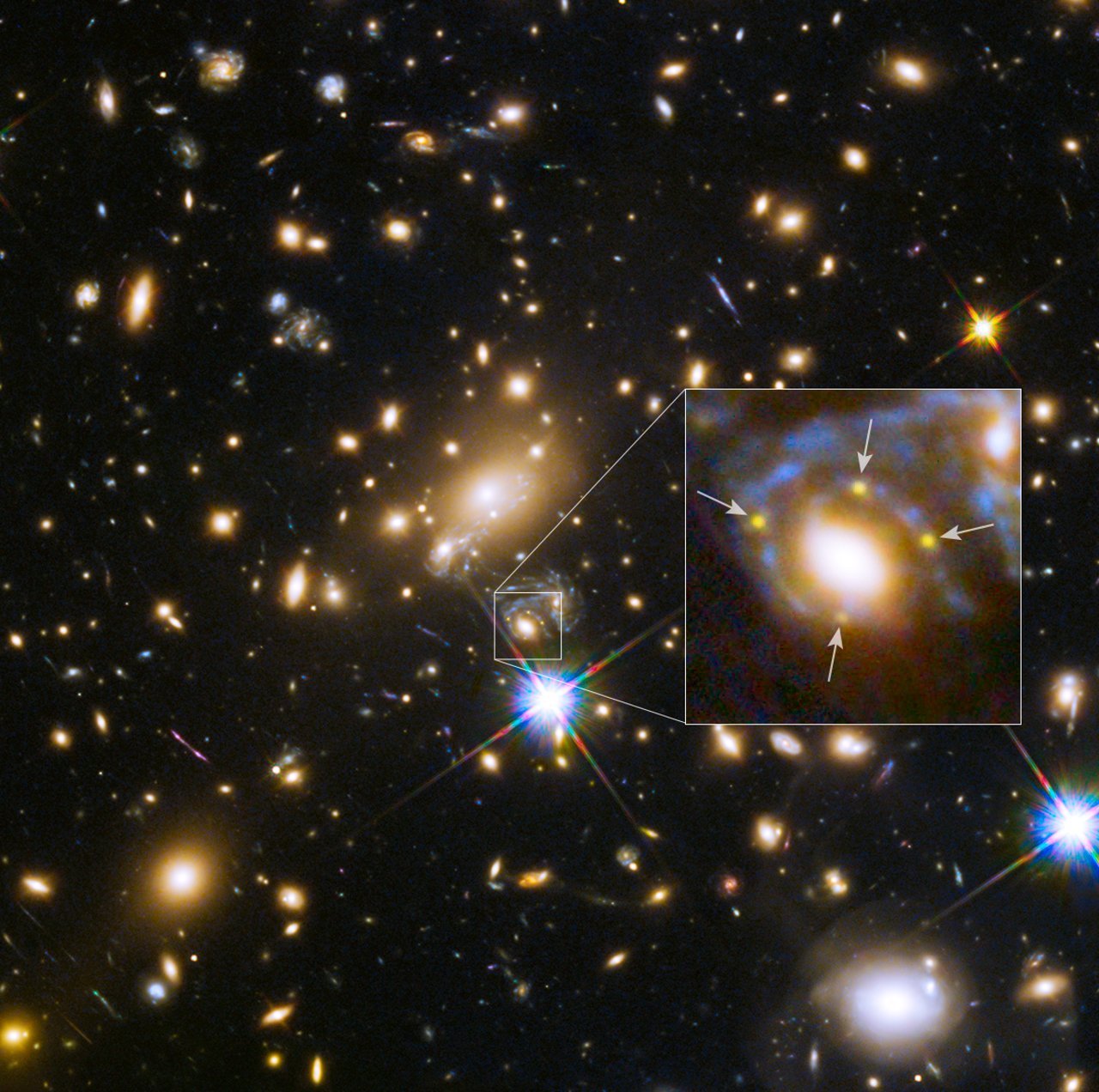
Astronomers using the NASA/ESA Hubble Space Telescope have, for the first time, spotted four images of a distant exploding star. The images are arranged in a cross-shaped pattern by the powerful gravity of a foreground galaxy embedded in a massive cluster of galaxies. The supernova discovery paper will appear on 6 March 2015 in a special issue of Science celebrating the centenary of Albert Einstein’s theory of general relativity.
Whilst looking closely at a massive elliptical galaxy and its associated galaxy clusterMACS J1149+2223 — whose light took over 5 billion years to reach us astronomers have spotted a strange and rare sight. The huge mass of the galaxy and the cluster is bending the light from a much more distant supernova behind them and creating four separate images of it. The light has been magnified and distorted due to gravitational lensing [1] and as a result the images are arranged around the elliptical galaxy in a formation known as an Einstein cross.
Although astronomers have discovered dozens of multiply imaged galaxies andquasars, they have never before seen multiple images of a stellar explosion.
“It really threw me for a loop when I spotted the four images surrounding the galaxy — it was a complete surprise,” said Patrick Kelly of the University of California Berkeley, USA, a member of the Grism Lens Amplified Survey from Space (GLASS)collaboration and lead author on the supernova discovery paper. He discovered the supernova during a routine search of the GLASS team’s data, finding what the GLASS group and the Frontier Fields Supernova team have been searching for since 2013 [2]. The teams are now working together to analyse the images of the supernova, whose light took over 9 billion years to reach us [3].
“The supernova appears about 20 times brighter than its natural brightness,”explains the paper’s co-author Jens Hjorth from the Dark Cosmology Centre, Denmark. “This is due to the combined effects of two overlapping lenses. The massive galaxy cluster focuses the supernova light along at least three separate paths, and then when one of those light paths happens to be precisely aligned with a single elliptical galaxy within the cluster, a secondary lensing effect occurs.” The dark matter associated with the elliptical galaxy bends and refocuses the light into four more paths, generating the rare Einstein cross pattern the team observed.
This unique observation will help astronomers refine their estimates of the amount and distribution of dark matter in the lensing galaxy and cluster. There is more dark matter in the Universe than visible matter, but it is extremely elusive and is only known to exist via its gravitational effects on the visible Universe, so the lensing effects of a galaxy or galaxy cluster are a big clue to the amount of dark matter it contains.
When the four supernova images fade away as the explosion dies down, astronomers will have a rare chance to catch a rerun of the explosion. The supernova images do not arrive at the Earth at the same time because, for each image produced, the light takes a different route. Each route has a different layout of matter — both dark and visible — along its path. this causes bends in the road, and so for some routes the light takes longer to reach us than for others. Astronomers can use their model of how much dark matter is in the cluster, and where it is, to predict when the next image will appear as well as using the time delays they observe to make the mass models even more accurate [4].
“The four supernova images captured by Hubble appeared within a few days or weeks of each other and we found them after they had appeared,” explains Steve Rodney of Johns Hopkins University, USA, leader of the Frontier Fields Supernova team. “But we think the supernova may have appeared in a single image some 20 years ago elsewhere in the cluster field, and, even more excitingly, it is expected to reappear once more in the next one to five years — and at that time we hope to catch it in action.”
The supernova has been nicknamed Refsdal in honor of Norwegian astronomer Sjur Refsdal, who, in 1964, first proposed using time-delayed images from a lensed supernova to study the expansion of the Universe. “Astronomers have been looking to find one ever since,” said Tommaso Treu of the University of California Los Angeles, USA, the GLASS project’s principal investigator. “And now the long wait is over!”

Notes

[1] Gravitational lensing was first predicted by Albert Einstein. This effect is similar to a glass lens bending light to magnify and distort the image of an object behind it.
[2] The Frontier Fields is a three-year programme that uses Hubble to observe six massive galaxy clusters to probe not only what is inside the clusters but also what is beyond them through gravitational lensing. The GLASS survey uses Hubble’s capabilities to study remote galaxies using ten massive galaxy clusters as gravitational lenses, including the six in the Frontier Fields.
[3] The team used the W. M. Keck Observatory on Mauna Kea, in Hawaii, to measure the redshift of the supernova’s host galaxy, which is a proxy to its distance.
[4] Measuring the time delays between images offers clues to the type of warped-space terrain the supernova’s light had to cover and will help the astronomers fine tune the models that map out the cluster’s mass.

Notes for editors

The Hubble Space Telescope is a project of international cooperation between ESA and NASA.
The international team of astronomers in this study consists of P. Kelly (University of California, Berkeley, USA); S. Rodney (The Johns Hopkins University, USA); T. Treu (University of California, Los Angeles, USA); R. Foley (University of Illinois at Urbana-Champaign, USA); G. Brammer (Space Telescope Science Institute, USA); K. Schmidt (University of California, Santa Barbara, USA); A. Zitrin (California Institute of Technology, USA); A. Sonnenfeld (University of California, Los Angeles, USA); L. Strolger (Space Telescope Science Institute, USA & Western Kentucky University, USA); O. Graur (New York University, USA), A. Filippenko (University of California, Berkeley, USA), S. Jha (Rutgers, USA); A. Riess (The Johns Hopkins University, USA & Space Telescope Science Institute, USA); M. Bradac (University of California, Davis, USA), B. Weiner (Steward Observatory, USA); D. Scolnic (The Johns Hopkins University, USA); M. Malkan (University of California, Los Angeles, USA); A. von der Linden (Dark Cosmology Centre, Denmark); M. Trenti (University of Melbourne, Australia); J. Hjorth (Dark Cosmology Centre, Denmark); R. Gavazzi (Institut d’Astrophysique de Paris, France); A. Fontana (INAF-OAR, Italy); J. Merten (California Institute of Technology, USA); C. McCully (University of California, Santa Barbara,, USA); T. Jones (University of California, Santa Barbara,, USA); M. Postman (Space Telescope Science Institute, USA); A. Dressler (Carnegie Observatories, USA), B. Patel (Rutgers, USA), S. Cenko (NASA/Goddard Space Flight Center, USA); M. Graham (University of California, Berkeley, USA); and Bradley E. Tucker (University of California, Berkeley, USA).

More information

Image credit: NASA, ESA, S. Rodney (John Hopkins University, USA) and the FrontierSN team; T. Treu (University of California Los Angeles, USA), P. Kelly (University of California Berkeley, USA) and the GLASS team; J. Lotz (STScI) and the Frontier Fields team; M. Postman (STScI) and the CLASH team; and Z. Levay (STScI)

Links

Mittwoch, 4. März 2015

Curiosity rover rendered armless by short circuit

Curiosity rover rendered armless by short circuit


Mars nuclear space tank parks after trouble strikes while retrieving sample

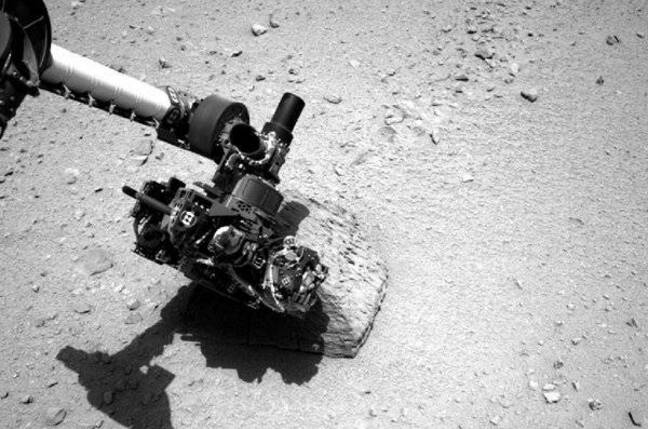
Curiosity's robotic arm probes first rock


04 March

Humanity's Mars-resident nuclear-powered, laser-packing space tank Curiosity has a broken arm.
NASA says the problem emerged on February 27th when "the rover was conducting an early step in the transfer of rock powder collected by the drill on the arm to laboratory instruments inside the rover."
During that operation "Telemetry received from the rover indicated that a transient short circuit occurred and the vehicle followed its programmed response, stopping the arm activity underway at the time of the irregularity in the electric current."
NASA has therefore parked Curiosity while it figures out what went wrong, and the status of the arm and the motors that power it.
"We are running tests on the vehicle in its present configuration before we move the arm or drive," said Curiosity project manager Jim Erickson.
The wounded arm has worked five times previously, transferring Martian soil samples to Curiosity's innards for detailed examinations.
It's not yet known what happened, or why, or if the rover can be remotely repaired.
NASA says "A transient short in some systems on the rover would have little effect on rover operations. In others, it could prompt the rover team to restrict use of a mechanism."
Here's hoping the former scenario is the outcome of this incident. ®

Montag, 8. Dezember 2014

New Horizons Wakes Up on Pluto's Doorstep

New Horizons Wakes Up on Pluto's Doorstep


Dec. 7, 2014: After a voyage of nearly nine years and three billion miles —the farthest any space mission has ever traveled to reach its primary target – NASA’s New Horizons spacecraft came out of hibernation on Dec. 6th for its long-awaited 2015 encounter with the Pluto system.
splash
New Horizons Mission Operations Manager Alice Bowman and operations team member Karl Whittenburg watch the screens for data confirming that the New Horizons spacecraft had transitioned from hibernation to active mode on Dec. 6.
Operators at the Johns Hopkins University Applied Physics Laboratory in Laurel, Md., confirmed at 9:53 p.m. (EST) that New Horizons, operating on pre-programmed computer commands, had switched from hibernation to “active” mode. Moving at light speed, the radio signal from New Horizons – currently more than 2.9 billion miles from Earth, and just over 162 million miles from Pluto – needed four hours and 26 minutes to reach NASA’s Deep Space Network station in Canberra, Australia. 
“This is a watershed event that signals the end of New Horizons crossing of a vast ocean of space to the very frontier of our solar system, and the beginning of the mission’s primary objective: the exploration of Pluto and its many moons in 2015,” said Alan Stern, New Horizons principal investigator from Southwest Research Institute, Boulder, Colo. 
Auroras Underfoot (signup)
Since launching on January 19, 2006, New Horizons has spent 1,873 days — about two-thirds of its flight time — in hibernation. Its 18 separate hibernation periods, from mid-2007 to late 2014, ranged from 36 days to 202 days in length. The team used hibernation to save wear and tear on spacecraft components and reduce the risk of system failures.
“Technically, this was routine, since the wake-up was a procedure that we’d done many times before,” said Glen Fountain, New Horizons project manager at APL. “Symbolically, however, this is a big deal. It means the start of our pre-encounter operations.”
The wake-up sequence had been programmed into New Horizons' onboard computer in August, and started aboard the spacecraft at 3 p.m. EST on Dec. 6. About 90 minutes later, New Horizons began transmitting word to Earth on its condition, including the report that it is back in "active" mode.
The New Horizons team will spend the next several weeks checking out the spacecraft, making sure its systems and science instruments are operating properly. They’ll also continue to build and test the computer-command sequences that will guide New Horizons through its flight to and reconnaissance of the Pluto system. 
image
For New Horizons, Russell Watson Records Special Version of ‘Where My Heart Will Take Me.’ Listen to it here
With a seven-instrument science payload that includes advanced imaging infrared and ultraviolet spectrometers, a compact multicolor camera, a high-resolution telescopic camera, two powerful particle spectrometers and a space-dust detector, New Horizons will begin observing the Pluto system on Jan. 15. 
New Horizons’ closest approach to Pluto will occur on July 14, but plenty of highlights are expected before then, including, by mid-May, views of the Pluto system better than what the Hubble Space Telescope can provide of the dwarf planet and its moons. 
A Musical Wake-Up
New Horizons joins the astronauts on four space shuttle missions who “woke up” to English tenor Russell Watson’s inspirational "Where My Heart Will Take Me" – in fact, Watson himself recorded a special greeting and version of the song to honor New Horizons! The song was played in New Horizons mission operations upon confirmation of the spacecraft’s wake-up on Dec. 6. 
The Sleeping Spacecraft: How Hibernation Worked
During hibernation mode, much of the New Horizons spacecraft was unpowered. The onboard flight computer monitored system health and broadcast a weekly beacon-status tone back to Earth. Onboard sequences sent in advance by mission controllers woke New Horizons two or three times each year to check out critical systems, calibrate instruments, gather some science data, rehearse Pluto-encounter activities, and perform course corrections.
New Horizons pioneered routine cruise-flight hibernation for NASA. Not only has hibernation reduced wear and tear on the spacecraft's electronics, it also lowered operations costs and freed up NASA Deep Space Network tracking and communication resources for other missions.
Credits:
Production editor: Dr. Tony Phillips | Credit: Science@NASA
More:
The Johns Hopkins Applied Physics Laboratory manages the New Horizons mission for NASA's Science Mission Directorate. Alan Stern, of the Southwest Research Institute (SwRI) is the principal investigator and leads the mission; SwRI leads the science team, payload operations, and encounter science planning. New Horizons is part of the New Frontiers Program managed by NASA's Marshall Space Flight Center in Huntsville, Alabama. APL designed, built and operates the New Horizons spacecraft.

Freitag, 7. November 2014

Jets, bubbles, and bursts of light in Taurus

Jets, bubbles, and bursts of light in Taurus

The NASA/ESA Hubble Space Telescope has snapped a striking view of a multiple star system called XZ Tauri, its neighbour HL Tauri, and several nearby young stellar objects. XZ Tauri is blowing a hot bubble of gas into the surrounding space, which is filled with bright and beautiful clumps that are emitting strong winds and jets. These objects illuminate the region, creating a truly dramatic scene.
This dark and ominous landscape is located some 450 light-years away in the constellation of Taurus (The Bull). It lies in the north-eastern part of a large, dark cloud known as LDN 1551.
Just to the left of centre in this image, embedded within a rust-coloured cloud, lies XZ Tauri. While it appears to be a single star, this bright spot actually consists of several stars. It has long been known to be a binary, but one of these two stars is thought also to be a binary, making a total of three stars within a single system.
This is not the first time that Hubble has observed XZ Tauri — between the years of 1995 and 2000, a hot bubble of gas was spotted expanding outwards from the system. This bubble can be seen as the small orange lobe very close to the top left of XZ Tauri. This gas is speeding out from the star system, leaving a trail spanning tens of billions of kilometres. As the bubble travels it hits slower moving material, triggering pulses of light and rippling shockwaves.
Above and to the right of XZ Tauri, an equally epic scene is unfolding. Wisps of deep red seem to be streaking away from the blue-tinged clumps on the right. This bright blue patch contains a star known as HL Tauri [1], which is associated with Herbig-Haro object HH 150. Herbig-Haro objects are streaks of hot gas blasted into space by newborn and newly forming stars and LDN 1551 is particularly rich in these dramatic objects.
In the bottom right of this Hubble image is another Herbig-Haro object known as HH 30 (opo9905), associated with the variable star V1213 Tauri. The star itself is hidden within a flat, bright disc of dust that is split in half by a dark lane. This dust blocks direct light from V1213 Tauri, but the star is visible via its reflected light and the prominent, knotty jets it is blasting out into space.
Hubble previously viewed HH 30, alongside XZ Tauri, with its Wide Field Planetary Camera 2 between the years of 1995 and 2000. The observations were used to image and study the changes in disc brightness and jet strength over the five-year period. V1213 Tauri’s strong magnetic field forms the jets by funnelling and shepherding gas from the disc, accelerating it along the star’s magnetic poles to form two narrow beams.
A version of this image was entered into the Hubble’s Hidden Treasures image processing competition by contestant Judy Schmidt, and won third prize.
In a press release issued by the European Southern Observatory today observations from the Atacama Large Millimeter/submillimeter Array (ALMA) reveal extraordinarily fine and never-before-seen detail in the planet-forming disc around HL Tauri. The new observations are an enormous step forward in the observation of how protoplanetary discs develop and how planets form.

Notes

[1] XZ Tauri and HL Tauri are textbook examples of a class of stars known as T Tauris — young and rapidly rotating, with strong magnetic fields and powerful winds. They have yet to reach the temperatures necessary for hydrogen fusion deep in their cores. It will take around 100 million years for these stars to trigger these reactions and evolve into fully-fledged stars like the Sun.

Notes for editors

The Hubble Space Telescope is a project of international cooperation between ESA and NASA.

More information

Image credit: ESA/Hubble and NASA
Acknowledgement: Judy Schmidt

Links

Freitag, 31. Oktober 2014

Yale finds a low-density planet that won’t stick to a schedule

Yale finds a low-density planet that won’t stick to a schedule

(Illustration by Michael S. Helfenbein)
For their latest discovery, Yale astronomers and the Planet Hunter program have found a low-mass, low-density planet with a punctuality problem.
The new planet, called PH3c, is located 2,300 light years from Earth and has an atmosphere loaded with hydrogen and helium. It is described in the Oct. 29 online edition of The Astrophysical Journal.
The elusive orb nearly avoided detection. This is because PH3c has a highly inconsistent orbit time around its sun, due to the gravitational influence of other planets in its system. “On Earth, these effects are very small, only on the scale of one second or so,” said Joseph Schmitt, a Yale graduate student and first author of the paper. “PH3c’s orbital period changed by 10.5 hours in just 10 orbits.”
That inconsistency kept it from being picked up by automated computer algorithms that search stellar light curves and identify regular dips caused by objects passing in front of stars.
Luckily, Planet Hunters came to the rescue. The program, which has found more than 60 planet candidates since 2010, enlists citizen scientists to check survey data from the Kepler spacecraft. Planet Hunters recently unveiled a new website and an expanded scientific mission.
“It harnesses the human dimension of science,” said Debra Fischer, who leads the exoplanets group at Yale and is a co-author of the paper. “Computers can’t find the unexpected, but people can, when they eyeball the data.”
More than 300,000 volunteers are part of Planet Hunters, which is coordinated by Yale and the University of Oxford. The program’s revamped website will allow Planet Hunters to analyze data more quickly than before, Fischer said. In addition, Planet Hunters is launching an effort to see if there is a correlation between types of stars and the planets that form around them.
“I think we’ll be able to contribute some really unique science this way,” Fischer said.
Not only did Planet Hunters spot PH3c, but the discovery also enabled astronomers to better characterize two other planets — one on each side of PH3c. An outer planet, PH3d, is slightly larger and heavier than Saturn, for example. An inner planet, PH3b, may have a rocky composition, like Earth.
“Finding the middle planet was key to confirming the others and allowing us to find their masses,” Schmitt said. “The outer planet’s orbital period also changes slightly, by about 10 minutes. You need to see both planets’ changing orbital periods in order to find out the masses of the planets. One planet doesn’t give enough information.”
There’s also a quirky aspect of the planetary trio, Schmitt added. The outer planet’s year is 1.91 times longer than the middle planet’s year, and the middle planet’s year is 1.91 times longer than the inner planet’s year.
“We’re not sure if this is just a coincidence or whether this might tell us something about how the planets were formed,” Schmitt said.
For more information about Planet Hunters, visit the website.
(Photo via Shutterstock)

Dienstag, 3. Juni 2014

NASA's 'Flying Saucer' Readies for First Test Flight

NASA's 'Flying Saucer' Readies for First Test Flight

June 2, 2014: It only sounds like science fiction.
To test a new technology for landing heavy payloads on Mars, NASA is about to drop a flying-saucer shaped vehicle from a helium balloon high above Earth's surface.
The first launch opportunity for the Low Density Supersonic Decelerator (LDSD) is June 3rd at 8:30 a.m. HST, when the launch window opens at the U.S. Navy's Pacific Missile Range Facility in Kauai, Hawaii.  Officials are calling it an "engineering shakeout flight."
splash
A saucer-shaped test vehicle holding equipment for landing large payloads on Mars is shown in the Missile Assembly Building at the US Navy's Pacific Missile Range Facility in Kaua‘i, Hawaii.  More
"The agency is moving forward and getting ready for Mars as part of NASA's Evolvable Mars campaign," says Michael Gazarik, associate administrator for Space Technology at NASA Headquarters in Washington. As NASA plans increasingly ambitious robotic missions to Mars, laying the groundwork for human science expeditions to come, missions will require larger and heavier spacecraft. The objective of the LDSD project is to see if the cutting-edge, rocket-powered test vehicle operates as it was designed -- in near-space at high Mach numbers.
The way NASA's saucer climbs to test altitude is almost as distinctive as the test vehicle itself.
Auroras Underfoot (signup)
"We use a helium balloon -- that, when fully inflated, would fit snugly into Pasadena's Rose Bowl -- to lift our vehicle to 120,000 feet," said Mark Adler, project manager for the Low Density Supersonic Decelerator at NASA's Jet Propulsion Laboratory. "From there we drop it for about one and a half seconds. After that, it's all about going higher and faster -- and then it's about putting on the brakes."
A fraction of a second after dropping from the balloon, and a few feet below it, four small rocket motors will fire to spin up and gyroscopically stabilize the saucer. A half second later, a Star 48B long-nozzle, solid-fueled rocket engine will kick in with 17,500 pounds of thrust, sending the test vehicle to the edge of the stratosphere.
image
A saucer-shaped vehicle designed to test interplanetary landing devices hangs on a tower in preparation for launch at the Pacific Missile Range. More
"Our goal is to get to an altitude and velocity which simulates the kind of environment one of our vehicles would encounter when it would fly in the Martian atmosphere," said Ian Clark, principal investigator of the LDSD project at JPL. "We top out at about 180,000 feet and Mach 4. Then, as we slow down to Mach 3.8, we deploy the first of two new atmospheric braking systems."
"After years of imagination, engineering and hard work, we soon will get to see our Keiki o ka honua, our 'boy from Earth,' show us its stuff," says Adler. "If our flying saucer hits its speed and altitude targets, it will be a great day."
The project management team decided also to fly two supersonic decelerator technologies that will be thoroughly tested during two more LDSD flight tests next year. If this year's test vehicle flies as expected, the LDSD team may get a treasure-trove of data on how the 6-meter supersonic inflatable aerodynamic decelerator (SIAD-R) and the supersonic parachute operate a full year ahead of schedule.
The SIAD-R, essentially an inflatable doughnut that increases the vehicle's size and, as a result, its drag, is deployed at about Mach 3.8. It will quickly slow the vehicle to Mach 2.5 where the parachute, the largest supersonic parachute ever flown, first hits the supersonic flow. About 45 minutes later, the saucer is expected to make a controlled landing onto the Pacific Ocean off Hawaii.
NASA TV will carry live images and commentary of LDSD engineering test. The test vehicle itself carries several onboard cameras. It is expected that video of selected portions of the test, including the rocket-powered ascent, will be downlinked during the commentary. Websites streaming live video of the test include http://www.nasa.gov/nasatv and http://www.ustream.tv/nasajpl2
Credits:
Production editor: Dr. Tony Phillips | Credit: Science@NASA

Freitag, 18. April 2014

A cross-section of the Universe

A cross-section of the Universe

17 April 2014

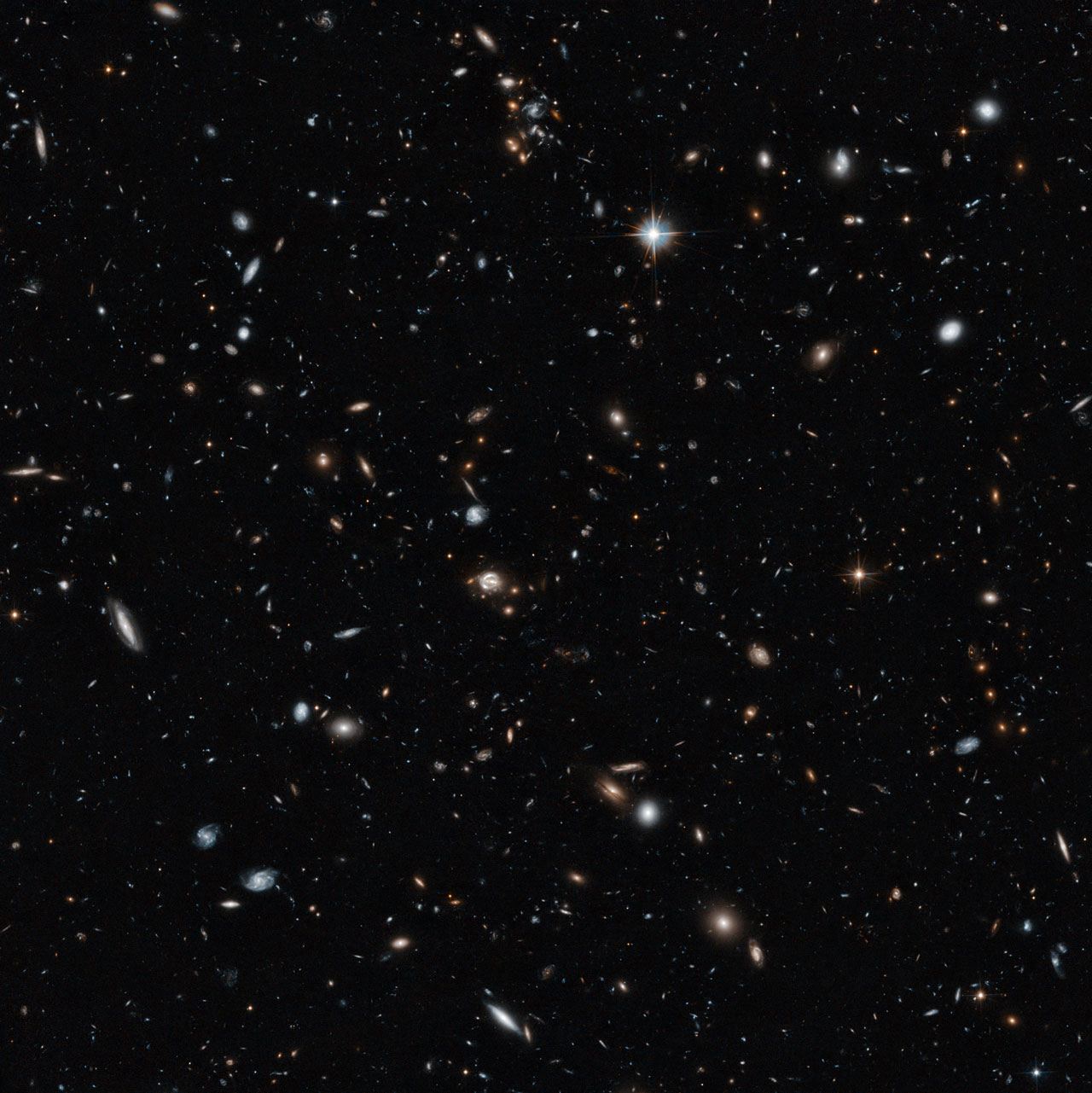
An image of a galaxy cluster taken by the NASA/ESA Hubble Space Telescope gives a remarkable cross-section of the Universe, showing objects at different distances and stages in cosmic history. They range from cosmic near neighbours to objects seen in the early years of the Universe. The 14-hour exposure shows objects around a billion times fainter than can be seen with the naked eye.
This new Hubble image showcases a remarkable variety of objects at different distances from us, extending back over halfway to the edge of the observable Universe. The galaxies in this image mostly lie about five billion light-years from Earth but the field also contains other objects, both significantly closer and far more distant.
Studies of this region of the sky have shown that many of the objects that appear to lie close together may actually be billions of light-years apart. This is because several groups of galaxies lie along our line of sight, creating something of an optical illusion. Hubble’s cross-section of the Universe is completed by distorted images of galaxies in the very distant background.
These objects are sometimes distorted due to a process called gravitational lensing, an extremely valuable technique in astronomy for studying very distant objects [1]. This lensing is caused by the bending of the space-time continuum by massive galaxies lying close to our line of sight to distant objects.
One of the lens systems visible here is called CLASS B1608+656, which appears as a small loop in the centre of the image. It features two foreground galaxies distorting and amplifying the light of a distant quasar the known as QSO-160913+653228. The light from this bright disc of matter, which is currently falling into a black hole, has taken nine billion years to reach us — two thirds of the age of the Universe.
As well as CLASS B1608+656, astronomers have identified two other gravitational lenses within this image. Two galaxies, dubbed Fred and Ginger by the researchers who studied them, contain enough mass to visibly distort the light from objects behind them. Fred, also known more prosaically as [FMK2006] ACS J160919+6532, lies near the lens galaxies in CLASS B1608+656, while Ginger ([FMK2006] ACS J160910+6532) is markedly closer to us. Despite their different distances from us, both can be seen near to CLASS B1608+656 in the central region of this Hubble image.
To capture distant and dim objects like these, Hubble required a long exposure. The image is made up of visible and infrared observations with a total exposure time of 14 hours.

Notes

[1] Gravitational lensing can amplify the light coming from distant objects, enabling telescopes like Hubble to see objects that would otherwise be too faint and far away. This effect will be exploited during the Frontier Fields observing campaign in the near future, which aims to combine the power of Hubble with the natural amplification caused by strong gravitational lensing of distant galaxy clusters, to study the past Universe.

More information

The Hubble Space Telescope is a project of international cooperation between ESA and NASA.
The image was spotted by contestant Adam Kill in the 2012 Hubble's Hidden Treasures competition. Hidden Treasures invited members of the public to search Hubble's science for the best overlooked images that have never been seen by a general audience. This image of CLASS B1608+656 has been well-studied by scientists over the years, but this is the first time it has been published in full online.

Links

Montag, 25. November 2013

Comet ISON vs. the Solar Storm

I love space, and you should not be surprised about that

This upcoming 'happening' is very intresting. For all the theories that are made around it, the danger, the unknown, makes me realize that, with the load of money invented in 'space research', we still absolutely do know only a very tiny bit of what is happenng in space.

Lovely

Comet ISON vs. the Solar Storm

Nov. 24, 2013:  In 2007, astronomers were amazed when a solar storm hit Comet Encke.  NASA STEREO spacecraft watched as a CME (coronal mass ejection) struck the comet head on and ripped off its tail.
image
A CME strikes Comet Encke in April 2007. MovieFull story
The same thing could be in store for Comet ISON--only worse.
On Nov. 28th, Comet ISON will pass through the sun's atmosphere, flying little more than a million kilometers above the sun's surface. It will be ~30 times closer to the sun than Encke was in 2007 and more likely to encounter a ferocious solar storm.
"For one thing," says Angelos Vourlidas of the Naval Research Lab and a participant in NASA's Comet ISON Observing Campaign (CIOC), "the year 2007 was near solar minimum. Solar activity was low. Now, however, we are near the peak of the solar cycle and eruptions are more frequent."
"I would absolutely love to see Comet ISON get hit by a big CME," says Karl Battams, an astronomer at the Naval Research Lab who also works with the CIOC. "It won't hurt the comet, but it would give us a chance to study extreme interactions with the comet's tail."
CMEs are magnetized clouds of plasma hurled into space by the explosions of sunspots.  The gas inside a CME is not very dense, so its impact would not shatter a comet's core. The fragile tail is another matter. Comet tails are as gossamer as the CMEs themselves, so the interactions can be intense and unpredictable.
Auroras Underfoot (signup)
"The CME that ran over Comet Encke back in 2007 was slow, barely creating a pressure pulse by compressing the solar wind ahead of it," notes Vourlidas. "It was this compression which caused the Encke's tail to fly off."
He believes that Comet ISON would experience something more dramatic. "Any CME that hits Comet ISON close to the sun would very likely be faster, driving a shock wave with a much stronger magnetic field.  Frankly, we can't predict what would happen."
Comet ISON entered the field of view of STEREO-A's Heliospheric Imager on Nov. 21st.  Coincidentally, Comet Encke is there, too. Presently, the two comets are being gently buffeted by solar wind and their tails are wagging back and forth accordingly.
splash
The Heliospheric Imager on NASA's STEREO-A spacecraft is tracking Comet ISON as it plunges toward the sun. In this movie, which spans a two day period from Nov. 20 to Nov. 22, 2013, the sun is off-screen to the right. Coincidentally, Comet Encke is present too. MovieCommentary
If the sun erupts, both comets could be engulfed by the same CME.  This would turn the two comets into solar probes.  Like wind socks, they would sample the storm from two widely separated locations, giving researchers a rare 3D view of a CME's inner structure.
Comet ISON will be passing over the sun's equator on Nov. 28th on the same side of the sun where a group of active sunspots was recently clustered.  In other words, says Battams, "we're going to be in the 'hot zone' for CMEs."
NASA's entire fleet of solar observatories will be watching when ISON takes the plunge.  This includes STEREO-A and STEREO-B, the Solar Dynamics Observatory, and the Solar and Heliophysics Observatory (SOHO), which NASA operates along with the European Space Agency. If a CME strikes the comet, all of the spacecraft are likely to see what happens.
"It would be pretty new territory for us," says Battams.
"...and a nice preview of what NASA's Solar Probe+ spacecraft might experience when it plunges into the sun in the 2020s," adds Vourlidas.
Stay tuned!
Credits:
Author: Dr. Tony Phillips | Production editor: Dr. Tony Phillips | Credit: Science@NASA

Samstag, 2. November 2013

The Sounds of Interstellar Space

The Sounds of Interstellar Space
Nov. 1, 2013:  Scifi movies are sometimes criticized when explosions in the void make noise.  As the old saying goes, “in space, no one can hear you scream.” Without air there is no sound.
But if that’s true, what was space physicist Don Gurnett talking about when he stated at a NASA press conference in Sept. 2013 that he had heard "the sounds of interstellar space?"
It turns out that space can make music … if you know how to listen.
splash
What does deep space sound like? A new ScienceCast video answers this question. Play it
Gurnett is the James Van Allen professor of physics at the University of Iowa and the principal investigator for the Plasma Wave Science instrument on Voyager 1.  At the press conference, he played some plasma wave data for the audience.  The sounds, he explained, were solid evidence that Voyager 1 had left the heliosphere.
The heliosphere is a vast bubble of magnetism that surrounds the sun and planets. It is, essentially, the sun’s magnetic field inflated to enormous proportions by the solar wind.  Inside the heliosphere is "home." Outside lies interstellar space, the realm of the stars.
Auroras Underfoot (signup)
For decades, researchers have been on the edge of their seats, waiting for the Voyager probes to leave.  Ironically, it took almost a year for NASA to realize the breakthrough had occurred. The reason is due to the slow cadence of transmissions from the distant spacecraft.  Data stored on old-fashioned tape recorders are played back at three to six month intervals. Then it takes more time to process the readings.
Gurnett recalls the thrill of discovery when some months-old data from the Plasma Wave Instrument reached his desk in the summer of 2013. The distant tones were conclusive: “Voyager 1 had made the crossing.”
Strictly speaking, the plasma wave instrument does not detect sound.  Instead it senses waves of electrons in the ionized gas or "plasma" that Voyager travels through. No human ear could hear these plasma waves.  Nevertheless, because they occur at audio frequencies, between a few hundred and a few thousand hertz, "we can play the data through a loudspeaker and listen," says Gurnett.  "The pitch and frequency tell us about the density of gas surrounding the spacecraft."
Nairas
Electron plasma oscillations: The evidence that Voyager 1 crossed into interstellar space. Listen
When Voyager 1 was inside the heliosphere, the tones were low, around 300 Hz, typical of plasma waves coursing through the rarified solar wind.   Outside, the frequency jumped to a higher pitch, between 2 and 3 kHz, corresponding to denser gas in the interstellar medium.  The transition music to Gurnett’s ears.
So far, Voyager 1 has recorded two outbursts of "interstellar plasma music"--one in Oct-Nov. 2012 and a second in April-May 2013.  Both were excited by bursts of solar activity.
“We need solar events to trigger plasma oscillations,” says Gurnett.
The key players are CMEs, hot clouds of gas that blast into space when solar magnetic fields erupt.  A typical CME takes 2 or 3 days to reach Earth, and a full year or more to reach Voyager.  When a CME passes through the plasma, it excites oscillations akin to fingers strumming the strings on a guitar.  Voyager’s Plasma Wave Instrument listens … and learns.
“We’re in a totally unexplored region of space,” says Gurnett.  “I expect some surprises out there.”
In particular, Gurnett is hoping for plasma waves not excited by solar storms. He speculates that shock fronts from outside the solar system could be rippling through the interstellar medium.  If so, they would excite new plasma waves that Voyager 1 will encounter as it plunges ever deeper into the realm of the stars. 
The next  "sounds" from out there could be surprising indeed.
Credits:
 Author: Dr. Tony Phillips | Production editor: Dr. Tony Phillips | Credit: Science@NASA