Translate

Posts mit dem Label mars werden angezeigt. Alle Posts anzeigen

Mittwoch, 4. März 2015

Curiosity rover rendered armless by short circuit

Curiosity rover rendered armless by short circuit


Mars nuclear space tank parks after trouble strikes while retrieving sample

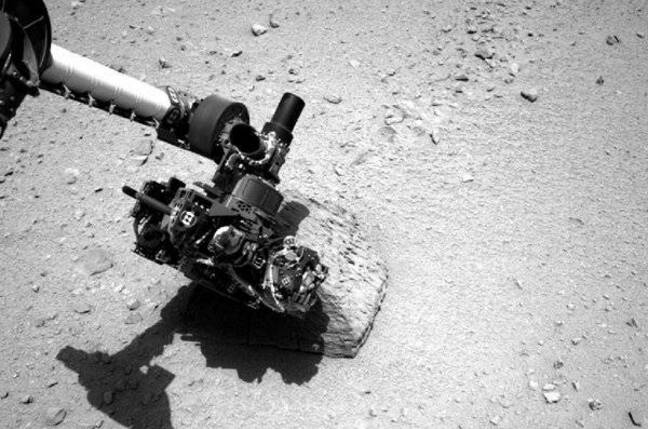
Curiosity's robotic arm probes first rock


04 March

Humanity's Mars-resident nuclear-powered, laser-packing space tank Curiosity has a broken arm.
NASA says the problem emerged on February 27th when "the rover was conducting an early step in the transfer of rock powder collected by the drill on the arm to laboratory instruments inside the rover."
During that operation "Telemetry received from the rover indicated that a transient short circuit occurred and the vehicle followed its programmed response, stopping the arm activity underway at the time of the irregularity in the electric current."
NASA has therefore parked Curiosity while it figures out what went wrong, and the status of the arm and the motors that power it.
"We are running tests on the vehicle in its present configuration before we move the arm or drive," said Curiosity project manager Jim Erickson.
The wounded arm has worked five times previously, transferring Martian soil samples to Curiosity's innards for detailed examinations.
It's not yet known what happened, or why, or if the rover can be remotely repaired.
NASA says "A transient short in some systems on the rover would have little effect on rover operations. In others, it could prompt the rover team to restrict use of a mechanism."
Here's hoping the former scenario is the outcome of this incident. ®

Mittwoch, 14. Januar 2015

Professor's BEAGLE, missing for 10 years, FOUND ON MARS

Professor's BEAGLE, missing for 10 years, FOUND ON MARS

British eggface lander's resting place uncovered by orbiter


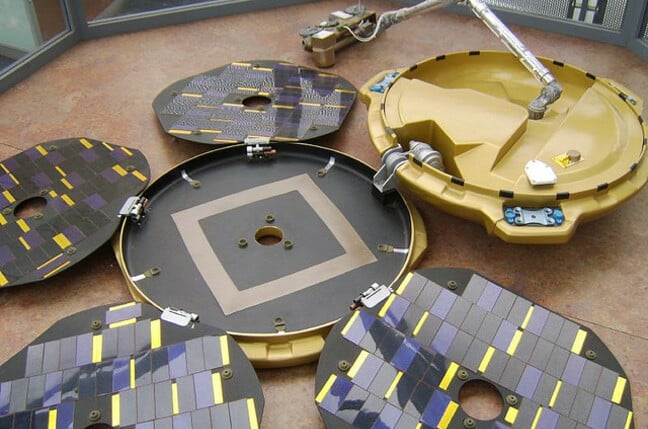
The long-lost, dustbin-lid sized British Mars lander Beagle 2 - whose fate had been unknown since it departed from its Mars Express mothership in orbit above the red planet on Christmas Day 2003 - seems likely to have been found at last.
The UK Space Agency has scheduled a press briefing on the Beagle for Friday and is refusing to discuss details in advance. However reports have it that boffins from NASA involved in managing the HiRISE (High Resolution Imaging Science Experiment) instrument aboard the American agency's Mars Reconnaissance Orbiter will be at the briefing.

“HiRise is the only camera at Mars that can see former spacecraft like Beagle 2. It’s definitely pretty close to its intended landing spot, no matter what. It entered the atmosphere at the right time and place,” said Shane Byrne, an Arizona university scientist on the HiRISE team quoted by the Guardian. Apparently NASA has been asked to keep details of the discovery under wraps ahead of Friday's briefing.
Beagle 2 travelled to Mars aboard the European Space Agency's Mars Express craft, which remains in orbit there. The diminutive British lander, built using different management arrangements from most spacecraft, was generally regarded as the brainchild of colourful scientist Professor Colin Pillinger - who has been described as "a proper British boffin".
The little lander detached from Mars Express on schedule, but was then never heard from again. The NASA HiRISE team have been actively searching for it for some time.
HiRISE has already managed to pick out the locations of various other human machines on the surface of Mars, including the Viking landers of the 1970s and the famous Curiosity and Opportunity rovers. It would appear that now the final resting place of the unfortunately defunct Beagle 2 has been discovered.
It's possible that the HiRISE imagery will offer some clue as to why the Beagle failed to get in touch - but mysteries may well remain, as even HiRISE will probably be offering just a few pixels of information.
We'll all know more on Friday - but sadly the information will come too late for Professor Pillinger, who passed away last year. ®

Dienstag, 9. Dezember 2014

Mars was a MOIST MISTRESS: Curiosity probes once-wet bottom

Mars was a MOIST MISTRESS: Curiosity probes once-wet bottom

Mount Sharp was immersed, nuclear droid finds


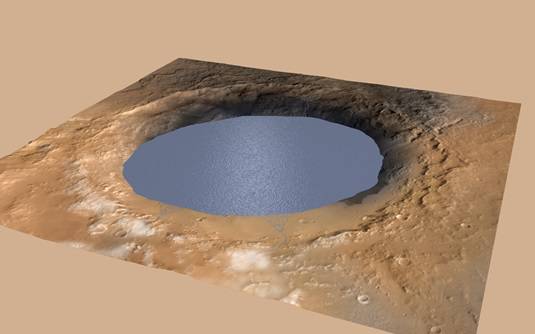
The nuclear powered Curiosity rover – right now rolling across three-mile-high Mount Sharp on Mars – has found evidence the great peak was once under a mighty lake.
Mount Sharp lake
A few billion years earlier and Curiosity would have needed water wings
"We are making headway in solving the mystery of Mount Sharp," said Curiosity Project Scientist John Grotzinger of the California Institute of Technology in Pasadena, California. "Where there's now a mountain, there may have once been a series of lakes."
Curiosity has already discovered the remains of an ancient riverbed on the Red Planet, but the latest discovery gives evidence of not only free-flowing water but large lakes that rose and fell over time.
"If our hypothesis for Mount Sharp holds up, it challenges the notion that warm and wet conditions were transient, local, or only underground on Mars," said Ashwin Vasavada, Curiosity deputy project scientist at NASA's Jet Propulsion Laboratory.
"A more radical explanation is that Mars' ancient, thicker atmosphere raised temperatures above freezing globally, but so far we don't know how the atmosphere did that."
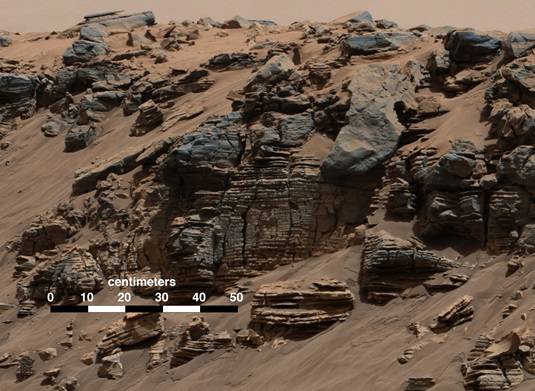
Sedimentary rocks at Mount Sharp
Analysis of the route to Mount Sharp shows the rover ran over what look like a series of hillocks that are similar to those found in dried up river deltas here on Earth. At the base of the mountain, Curiosity spotted layers of sedimentary rock interspersed with erosion caused by the wind during repeated filling and emptying of the lake.
"The great thing about a lake that occurs repeatedly, over and over, is that each time it comes back it is another experiment to tell you how the environment works," Grotzinger said.
"As Curiosity climbs higher on Mount Sharp, we will have a series of experiments to show patterns in how the atmosphere and the water and the sediments interact. We may see how the chemistry changed in the lakes over time. This is a hypothesis supported by what we have observed so far, providing a framework for testing in the coming year." ®

Dienstag, 3. Juni 2014

NASA's 'Flying Saucer' Readies for First Test Flight

NASA's 'Flying Saucer' Readies for First Test Flight

June 2, 2014: It only sounds like science fiction.
To test a new technology for landing heavy payloads on Mars, NASA is about to drop a flying-saucer shaped vehicle from a helium balloon high above Earth's surface.
The first launch opportunity for the Low Density Supersonic Decelerator (LDSD) is June 3rd at 8:30 a.m. HST, when the launch window opens at the U.S. Navy's Pacific Missile Range Facility in Kauai, Hawaii.  Officials are calling it an "engineering shakeout flight."
splash
A saucer-shaped test vehicle holding equipment for landing large payloads on Mars is shown in the Missile Assembly Building at the US Navy's Pacific Missile Range Facility in Kaua‘i, Hawaii.  More
"The agency is moving forward and getting ready for Mars as part of NASA's Evolvable Mars campaign," says Michael Gazarik, associate administrator for Space Technology at NASA Headquarters in Washington. As NASA plans increasingly ambitious robotic missions to Mars, laying the groundwork for human science expeditions to come, missions will require larger and heavier spacecraft. The objective of the LDSD project is to see if the cutting-edge, rocket-powered test vehicle operates as it was designed -- in near-space at high Mach numbers.
The way NASA's saucer climbs to test altitude is almost as distinctive as the test vehicle itself.
Auroras Underfoot (signup)
"We use a helium balloon -- that, when fully inflated, would fit snugly into Pasadena's Rose Bowl -- to lift our vehicle to 120,000 feet," said Mark Adler, project manager for the Low Density Supersonic Decelerator at NASA's Jet Propulsion Laboratory. "From there we drop it for about one and a half seconds. After that, it's all about going higher and faster -- and then it's about putting on the brakes."
A fraction of a second after dropping from the balloon, and a few feet below it, four small rocket motors will fire to spin up and gyroscopically stabilize the saucer. A half second later, a Star 48B long-nozzle, solid-fueled rocket engine will kick in with 17,500 pounds of thrust, sending the test vehicle to the edge of the stratosphere.
image
A saucer-shaped vehicle designed to test interplanetary landing devices hangs on a tower in preparation for launch at the Pacific Missile Range. More
"Our goal is to get to an altitude and velocity which simulates the kind of environment one of our vehicles would encounter when it would fly in the Martian atmosphere," said Ian Clark, principal investigator of the LDSD project at JPL. "We top out at about 180,000 feet and Mach 4. Then, as we slow down to Mach 3.8, we deploy the first of two new atmospheric braking systems."
"After years of imagination, engineering and hard work, we soon will get to see our Keiki o ka honua, our 'boy from Earth,' show us its stuff," says Adler. "If our flying saucer hits its speed and altitude targets, it will be a great day."
The project management team decided also to fly two supersonic decelerator technologies that will be thoroughly tested during two more LDSD flight tests next year. If this year's test vehicle flies as expected, the LDSD team may get a treasure-trove of data on how the 6-meter supersonic inflatable aerodynamic decelerator (SIAD-R) and the supersonic parachute operate a full year ahead of schedule.
The SIAD-R, essentially an inflatable doughnut that increases the vehicle's size and, as a result, its drag, is deployed at about Mach 3.8. It will quickly slow the vehicle to Mach 2.5 where the parachute, the largest supersonic parachute ever flown, first hits the supersonic flow. About 45 minutes later, the saucer is expected to make a controlled landing onto the Pacific Ocean off Hawaii.
NASA TV will carry live images and commentary of LDSD engineering test. The test vehicle itself carries several onboard cameras. It is expected that video of selected portions of the test, including the rocket-powered ascent, will be downlinked during the commentary. Websites streaming live video of the test include http://www.nasa.gov/nasatv and http://www.ustream.tv/nasajpl2
Credits:
Production editor: Dr. Tony Phillips | Credit: Science@NASA