Translate

Posts mit dem Label nasa werden angezeigt. Alle Posts anzeigen

Montag, 19. Oktober 2015

Starburst galaxy Messier 94

Starburst galaxy Messier 94

This image shows the galaxy Messier 94, which lies in the small northern constellation of the Hunting Dogs, about 16 million light-years away.
Within the bright ring around Messier 94 new stars are forming at a high rate and many young, bright stars are present within it – thanks to this, this feature is called a starburst ring.
The cause of this peculiarly shaped star-forming region is likely a pressure wave going outwards from the galactic centre, compressing the gas and dust in the outer region. The compression of material means the gas starts to collapse into denser clouds. Inside these dense clouds, gravity pulls the gas and dust together until temperature and pressure are high enough for stars to be born.
Credit:
ESA/Hubble & NASA

Mittwoch, 14. Oktober 2015

Hubble’s planetary portrait captures changes in Jupiter’s Great Red Spot

Hubble’s planetary portrait captures changes in Jupiter’s Great Red Spot

13 October 2015
Scientists using the NASA/ESA Hubble Space Telescope have produced new maps of Jupiter that show the continuing changes in its famous Great Red Spot. The images also reveal a rare wave structure in the planet’s atmosphere that has not been seen for decades. The new image is the first in a series of annual portraits of the Solar System’s outer planets, which will give us new glimpses of these remote worlds, and help scientists to study how they change over time.
In this new image of Jupiter a broad range of features has been captured, including winds, clouds and storms. The scientists behind the new images took pictures of Jupiter using Hubble’s Wide Field Camera 3 over a ten-hour period and have produced two maps of the entire planet from the observations. These maps make it possible to determine the speeds of Jupiter’s winds, to identify different phenomena in its atmosphere and to track changes in its most famous features.
The new images confirm that the huge storm, which has raged on Jupiter’s surface for at least three hundred years, continues to shrink, but that it may not go out without a fight. The storm, known as the Great Red Spot, is seen here swirling at the centre of the image of the planet. It has been decreasing in size at a noticeably faster rate from year to year for some time. But now, the rate of shrinkage seems to be slowing again, even though the spot is still about 240 kilometres smaller than it was in 2014.
The spot’s size is not the only change that has been captured by Hubble. At the centre of the spot, which is less intense in colour than it once was, an unusual wispy filament can be seen spanning almost the entire width of the vortex. This filamentary streamer rotates and twists throughout the ten-hour span of the Great Red Spot image sequence, distorted by winds that are blowing at 540 kilometres per hour.
There is another feature of interest in this new view of our giant neighbour. Just north of the planet’s equator, researchers have found a rare wave structure, of a type that has been spotted on the planet only once before, decades ago by the Voyager 2 mission, which was launched in 1977. In the Voyager 2 images the wave was barely visible and astronomers began to think its appearance was a fluke, as nothing like it has been seen since, until now.
The current wave was found in a region dotted with cyclones and anticyclones. Similar waves — called baroclinic waves — sometimes appear in the Earth’s atmosphere where cyclones are forming. The wave may originate in a clear layer beneath the clouds, only becoming visible when it propagates up into the cloud deck, according to the researchers.
The observations of Jupiter form part of the Outer Planet Atmospheres Legacy (OPAL) programme, which will allow Hubble to dedicate time each year to observing the outer planets. In addition to Jupiter, Neptune and Uranus have already been observed as part of the programme and maps of these planets will be placed in the public archive. Saturn will be added to the series later. The collection of maps that will be built up over time will help scientists not only to understand the atmospheres of giant planets in the Solar System, but also the atmospheres of our own planet and of the planets that are being discovered around other stars.

Notes

The findings are described in an Astrophysical Journal paper First results from the Hubble OPAL program: Jupiter in 2015, available online.

Notes for editors

The Hubble Space Telescope is a project of international cooperation between ESA and NASA.

More information

Image credit: NASA, ESA, A. Simon (GSFC), M. Wong (UC Berkeley), and G. Orton (JPL-Caltech)

Links


Dienstag, 11. August 2015

A Good Year for Perseid Meteors

A Good Year for Perseid Meteors
Aug. 11, 2015: Moonlight is ethereal, enchanting, romantic.  For many sky watchers, nothing beats the luminous beauty of a full Moon.
It’s great …. except during a meteor shower.  When Earth passes through a stream of comet dust, all that romantic moonlight turns into a nuisance, overwhelming the fainter display of shooting stars.
Now for the good news:  The 2015 Perseid meteor shower is here, and the Moon will be dark when it peaks.
This week, Earth passes through a stream of debris from Comet Swift-Tuttle, source of the annual Perseid meteor shower. Forecasters say the show could be especially good this year because the Moon is nearly new when the shower peaks on Aug. 12-13.
“This year’s Perseid meteor shower peaks on August 12th and 13th,” says Bill Cooke of NASA’s Meteoroid Environment Office.  “The Moon will be nearly new, setting the stage for a great display.”
The Perseid meteor shower is caused by debris from Comet Swift-Tuttle. Every 133 years the huge comet swings through the inner solar system and ejects a trail of dust and gravel along its orbit. When Earth passes through the debris, specks of comet-stuff hit the atmosphere at 140,000 mph and disintegrate in flashes of light.
Swift-Tuttle's debris zone is so wide that Earth spends weeks inside it. Indeed, it is not unusual for sky watchers to see a few Perseids streaking across the midnight sky as early as July.   Rates are highest, however, in August when Earth passes through the heart of the debris zone.
Auroras Underfoot (signup)
Last year, the Perseid meteor shower peaked during the nights around a bright “supermoon.”  Lunar glare reduced the visibility of the Perseids as much as 5 fold to as few as 20 per hour. This year however, is different.
Under a clear, dark sky far from city lights, “We expect meteor rates as high as 100 per hour on peak night,” says Cooke.
Meteors from Comet Swift-Tuttle are called Perseids because they seem to fly out of the constellation Perseus. This arrangement of stars, which represents an ancient hero from Greek mythology, rises in the NE around 10 pm local time. As Perseus rises and the night deepens, meteor rates will increase. The best time to look starts around midnight.  Meteors will be seen until  dawn brightens the sky on Thursday morning, Aug. 13th, when Perseus is near its highest point in the sky.
For best results, get away from city lights. The darkness of the countryside multiplies the visible meteor rate 3- to 10-fold compared to city views. Many families plan camping trips to coincide with the Perseids. The Milky Way arching over a mountain campground provides the perfect backdrop for a meteor shower.
The Moon is new. Enjoy the show!

Freitag, 27. März 2015

NASA: We're gonna rip up an ASTEROID and make it ORBIT the MOON

NASA: We're gonna rip up an ASTEROID and make it ORBIT the MOON

Asteroid Redirection Mission plans to use microgravity to deflect flying rocks

NASA has decided that putting a lump of rock from an asteroid into orbit around the Moon is better than trying to hook a whole asteroid.
The ARM – Asteroid Redirection Mission – has settled on what the space agency called “Option B”, sending a spacecraft to a near-Earth asteroid big enough to have boulders on the surface and using robotic grapples to retrieve a rock and put it in a stable orbit around the moon.
“Option A” would have been to find a suitable asteroid less than 10 metres in diameter for redirection.
Reporting from the NASA press conference, Spacenews quotes associate administrator Ross Lightfoot as saying that settling on a boulder rather than grabbing a whole asteroid will give the agency more options.
“I'm going to have multiple targets when I get there”, Lightfoot said. “That's what it boils down to.”
So far, NASA says it's identified three possible candidates for the mission, known as Itokawa, Bennu, and 2008 EV5.
It expects to identify more candidates as the years go by, noting that in the three years of its asteroid initiative, it's increased the detection of near-Earth asteroids by 65 per cent.
The ARM target will be finalised by 2019, NASA says, based on size, rotation, shape and orbit.
As part of the preparation for an eventual mission to Mars, the ARM spacecraft will be the test-bed for a number of technologies, including an advanced Solar Electric Propulsion (SEP) ion drive.
While SEP will be slower than lighting a fire under a bloody big rocketTM, it needs a lot less propellant.
The ARM project will also offer a test-bed for “planetary defense techniques”, including using the small gravity of a nearby spacecraft to disturb an asteroid's orbit enough that something on a potential Earth-impact path would pass us by.
As NASA notes, “effectiveness of this manoeuvre is increased, moreover, if mass is moved from the asteroid to the spacecraft by the capture of a boulder”.
NASA plans to send a 24-25 day crewed mission to the captured lump of rock in the mid-2020s, launching an Orion spacecraft on the Space Launch System.
The agency hopes to get $US50 million for the ARM project in its 2016 budget.
NASA's 2014 video explaining the ARM is below. ®


Mittwoch, 14. Januar 2015

Professor's BEAGLE, missing for 10 years, FOUND ON MARS

Professor's BEAGLE, missing for 10 years, FOUND ON MARS

British eggface lander's resting place uncovered by orbiter


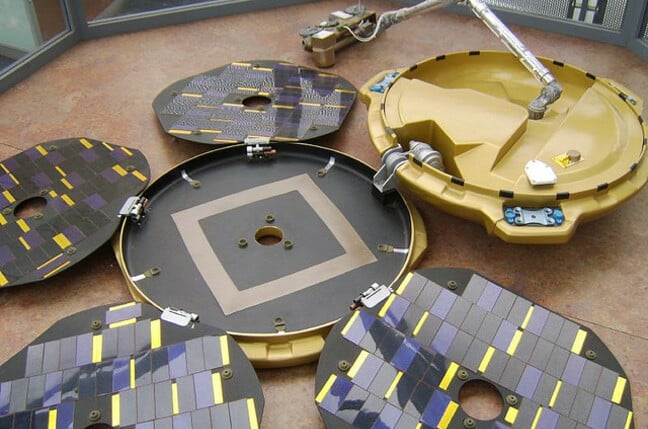
The long-lost, dustbin-lid sized British Mars lander Beagle 2 - whose fate had been unknown since it departed from its Mars Express mothership in orbit above the red planet on Christmas Day 2003 - seems likely to have been found at last.
The UK Space Agency has scheduled a press briefing on the Beagle for Friday and is refusing to discuss details in advance. However reports have it that boffins from NASA involved in managing the HiRISE (High Resolution Imaging Science Experiment) instrument aboard the American agency's Mars Reconnaissance Orbiter will be at the briefing.

“HiRise is the only camera at Mars that can see former spacecraft like Beagle 2. It’s definitely pretty close to its intended landing spot, no matter what. It entered the atmosphere at the right time and place,” said Shane Byrne, an Arizona university scientist on the HiRISE team quoted by the Guardian. Apparently NASA has been asked to keep details of the discovery under wraps ahead of Friday's briefing.
Beagle 2 travelled to Mars aboard the European Space Agency's Mars Express craft, which remains in orbit there. The diminutive British lander, built using different management arrangements from most spacecraft, was generally regarded as the brainchild of colourful scientist Professor Colin Pillinger - who has been described as "a proper British boffin".
The little lander detached from Mars Express on schedule, but was then never heard from again. The NASA HiRISE team have been actively searching for it for some time.
HiRISE has already managed to pick out the locations of various other human machines on the surface of Mars, including the Viking landers of the 1970s and the famous Curiosity and Opportunity rovers. It would appear that now the final resting place of the unfortunately defunct Beagle 2 has been discovered.
It's possible that the HiRISE imagery will offer some clue as to why the Beagle failed to get in touch - but mysteries may well remain, as even HiRISE will probably be offering just a few pixels of information.
We'll all know more on Friday - but sadly the information will come too late for Professor Pillinger, who passed away last year. ®

Dienstag, 16. Dezember 2014

Carnegie Hosts Crater-Naming Contest

Carnegie Hosts Crater-Naming Contest

Washington, D.C—The MESSENGER Education and Public Outreach (EPO) Team is launching a competition this week to namefive impact craters on Mercury. The contest is open to all Earthlings, except for members of the mission’s EPO team. The contest runs from December 15, 2014, to January 15, 2015.
NASA’s MESSENGER spacecraft has been in orbit about Mercury since March 2011. The mission’s EPO team is led by Julie Edmonds of the Carnegie Institution for Science.
According to the International Astronomical Union (IAU)—the governing body of planetary and satellite nomenclature since 1919—all new craters on Mercury must be named after an artist, composer, or writer who was famous for more than 50 years and has been dead for more than three years. See the current list of named Mercury craters.
The EPO team’s contest allows the public to immortalize an important person in the arts and humanities from anywhere in the world. Submissions will be accepted beginning midnight (00:00 UTC) on December 15, 2014, until January 15, 2015 (23:59 UTC). Fifteen finalist names for craters will be submitted to theInternational Astronomical Union (IAU) for selection of the five winners. Winning submissions will be announced by the IAU to coincide with the end of MESSENGER’s orbital operations in late March or April 2015. IAU decisions will be final.
The MESSENGER spacecraft has far surpassed expectations both in the duration of the mission and in the quality and quantity of data. The mission will end this spring as the tiny craft succumbs to gravity and impacts on Mercury. The EPO team organized the competition to celebrate the mission’s achievements.
Edmonds advises participants to first research the artist, composer, or writer under consideration before filling out the contest entry. “Once online, registrants will be asked to submit a short description of their chosen individual’s contributions to their field, as well as an authoritative source for background information,” she said.
The name cannot have any political, religious, or military significance. Nor can other features in the Solar System have the same name. For example, Ansel Adams is not eligible because there is a feature on the Moon with the name Adams (even though it was not named for Ansel). Participants can check their ideas against the list of named Solar System features and enter the name in the “Search by Feature Name” box in the upper right corner.
“This brave little craft, not much bigger than a Volkswagen Beetle, has travelled more than 8 billion miles since 2004—getting to the planet and then in orbit,” Edmonds said. “We would like to draw international attention to the achievements of the mission and the guiding engineers and scientists on Earth who have made the MESSENGER mission so outstandingly successful.”
The goal of MESSENGER was to take 2,500 images of the planet, but is has returned more than 250,000 images. “We now have a detailed, high-resolution map of the entire planet,” Edmonds noted. “As scientists study the incredible data returned by MESSENGER, it becomes important to give names to surface features that are of special scientific interest. Having names for landforms such as mountains, craters, and cliffs makes it easier for scientists and others to communicate.”
Enter the contest online at http://namecraters.carnegiescience.edu/.
________________________________________
The Carnegie Institution for Science (carnegiescience.edu) is a private, nonprofit organization headquartered in Washington, D.C., with six research departments throughout the U.S. Since its founding in 1902, the Carnegie Institution has been a pioneering force in basic scientific research. Carnegie scientists are leaders in plant biology, developmental biology, astronomy, materials science, global ecology, and Earth and planetary science.
MESSENGER (MErcury Surface, Space ENvironment, GEochemistry, and Ranging) is a NASA-sponsored scientific investigation of the planet Mercury and the first space mission designed to orbit the planet closest to the Sun. The MESSENGER spacecraft was launched on August 3, 2004, and entered orbit about Mercury on March 18, 2011 (UTC), to begin its primary mission – a yearlong study of its target planet. MESSENGER’s first extended mission began on March 18, 2012, and ended one year later. MESSENGER is now in a second extended mission, which is scheduled to conclude in late March or April 2015. Sean C. Solomon, the Director of Columbia University's Lamont-Doherty Earth Observatory, leads the mission as Principal Investigator. The Johns Hopkins University Applied Physics Laboratory built and operates the MESSENGER spacecraft and manages this Discovery-class mission for NASA.

NASA Voyager: 'Tsunami Wave' Still Flies Through Interstellar Space

NASA Voyager: 'Tsunami Wave' Still Flies Through Interstellar Space


NEWS | DECEMBER 15, 2014


Voyager in Space (Artist Concept)
This artist's concept shows NASA's Voyager spacecraft against a backdrop of stars. Image credit: NASA/JPL-Caltech
› Full image and caption
• The Voyager 1 spacecraft has experienced three shock waves
• The most recent shock wave, first observed in February 2014, still appears to be going on
• One wave, previously reported, helped researchers determine that Voyager 1 had entered interstellar space
The "tsunami wave" that NASA's Voyager 1 spacecraft began experiencing earlier this year is still propagating outward, according to new results. It is the longest-lasting shock wave that researchers have seen in interstellar space.
"Most people would have thought the interstellar medium would have been smooth and quiet. But these shock waves seem to be more common than we thought," said Don Gurnett, professor of physics at the University of Iowa in Iowa City. Gurnett presented the new data Monday, Dec. 15 at the American Geophysical Union meeting in San Francisco.
A "tsunami wave" occurs when the sun emits a coronal mass ejection, throwing out a magnetic cloud of plasma from its surface. This generates a wave of pressure. When the wave runs into the interstellar plasma -- the charged particles found in the space between the stars -- a shock wave results that perturbs the plasma.
"The tsunami causes the ionized gas that is out there to resonate -- "sing" or vibrate like a bell," said Ed Stone, project scientist for the Voyager mission based at California Institute of Technology in Pasadena.
This is the third shock wave that Voyager 1 has experienced. The first event was in October to November of 2012, and the second wave in April to May of 2013 revealed an even higher plasma density. Voyager 1 detected the most recent event in February, and it is still going on as of November data. The spacecraft has moved outward 250 million miles (400 million kilometers) during the third event.
"This remarkable event raises questions that will stimulate new studies of the nature of shocks in the interstellar medium," said Leonard Burlaga, astrophysicist emeritus at NASA Goddard Spaceflight Center in Greenbelt, Maryland, who analyzed the magnetic field data that were key to these results.
It is unclear to researchers what the unusual longevity of this particular wave may mean. They are also uncertain as to how fast the wave is moving or how broad a region it covers.
The second tsunami wave helped researchers determine in 2013 that Voyager 1 had left the heliosphere, the bubble created by the solar wind encompassing the sun and the planets in our solar system. Denser plasma "rings" at a higher frequency, and the medium that Voyager flew through, was 40 times denser than what had been previously measured. This was key to the conclusion that Voyager had entered a frontier where no spacecraft had gone before: interstellar space.
"The density of the plasma is higher the farther Voyager goes," Stone said. "Is that because the interstellar medium is denser as Voyager moves away from the heliosphere, or is it from the shock wave itself? We don't know yet."
Gurnett, principal investigator of the plasma wave instrument on Voyager, expects that such shock waves propagate far out into space, perhaps even to twice the distance between the sun and where the spacecraft is right now.
Voyager 1 and its twin, Voyager 2, were launched 16 days apart in 1977. Both spacecraft flew by Jupiter and Saturn. Voyager 2 also flew by Uranus and Neptune. Voyager 2, launched before Voyager 1, is the longest continuously operated spacecraft and is expected to enter interstellar space in a few years.
JPL, a division of Caltech, built the twin Voyager spacecraft and operates them for the Heliophysics Division within NASA's Science Mission Directorate in Washington.
For more information on the Voyager mission, visit:


Dienstag, 9. Dezember 2014

Mars was a MOIST MISTRESS: Curiosity probes once-wet bottom

Mars was a MOIST MISTRESS: Curiosity probes once-wet bottom

Mount Sharp was immersed, nuclear droid finds


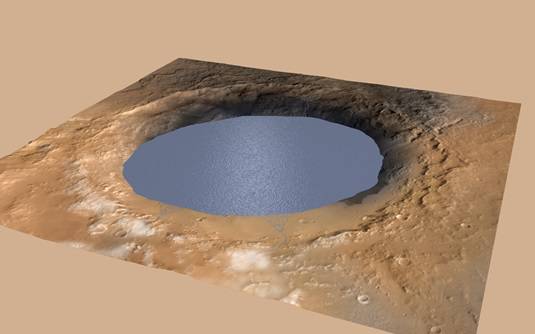
The nuclear powered Curiosity rover – right now rolling across three-mile-high Mount Sharp on Mars – has found evidence the great peak was once under a mighty lake.
Mount Sharp lake
A few billion years earlier and Curiosity would have needed water wings
"We are making headway in solving the mystery of Mount Sharp," said Curiosity Project Scientist John Grotzinger of the California Institute of Technology in Pasadena, California. "Where there's now a mountain, there may have once been a series of lakes."
Curiosity has already discovered the remains of an ancient riverbed on the Red Planet, but the latest discovery gives evidence of not only free-flowing water but large lakes that rose and fell over time.
"If our hypothesis for Mount Sharp holds up, it challenges the notion that warm and wet conditions were transient, local, or only underground on Mars," said Ashwin Vasavada, Curiosity deputy project scientist at NASA's Jet Propulsion Laboratory.
"A more radical explanation is that Mars' ancient, thicker atmosphere raised temperatures above freezing globally, but so far we don't know how the atmosphere did that."
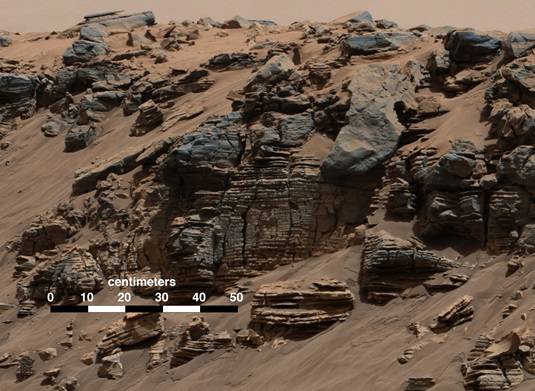
Sedimentary rocks at Mount Sharp
Analysis of the route to Mount Sharp shows the rover ran over what look like a series of hillocks that are similar to those found in dried up river deltas here on Earth. At the base of the mountain, Curiosity spotted layers of sedimentary rock interspersed with erosion caused by the wind during repeated filling and emptying of the lake.
"The great thing about a lake that occurs repeatedly, over and over, is that each time it comes back it is another experiment to tell you how the environment works," Grotzinger said.
"As Curiosity climbs higher on Mount Sharp, we will have a series of experiments to show patterns in how the atmosphere and the water and the sediments interact. We may see how the chemistry changed in the lakes over time. This is a hypothesis supported by what we have observed so far, providing a framework for testing in the coming year." ®

Montag, 8. Dezember 2014

New Horizons Wakes Up on Pluto's Doorstep

New Horizons Wakes Up on Pluto's Doorstep


Dec. 7, 2014: After a voyage of nearly nine years and three billion miles —the farthest any space mission has ever traveled to reach its primary target – NASA’s New Horizons spacecraft came out of hibernation on Dec. 6th for its long-awaited 2015 encounter with the Pluto system.
splash
New Horizons Mission Operations Manager Alice Bowman and operations team member Karl Whittenburg watch the screens for data confirming that the New Horizons spacecraft had transitioned from hibernation to active mode on Dec. 6.
Operators at the Johns Hopkins University Applied Physics Laboratory in Laurel, Md., confirmed at 9:53 p.m. (EST) that New Horizons, operating on pre-programmed computer commands, had switched from hibernation to “active” mode. Moving at light speed, the radio signal from New Horizons – currently more than 2.9 billion miles from Earth, and just over 162 million miles from Pluto – needed four hours and 26 minutes to reach NASA’s Deep Space Network station in Canberra, Australia. 
“This is a watershed event that signals the end of New Horizons crossing of a vast ocean of space to the very frontier of our solar system, and the beginning of the mission’s primary objective: the exploration of Pluto and its many moons in 2015,” said Alan Stern, New Horizons principal investigator from Southwest Research Institute, Boulder, Colo. 
Auroras Underfoot (signup)
Since launching on January 19, 2006, New Horizons has spent 1,873 days — about two-thirds of its flight time — in hibernation. Its 18 separate hibernation periods, from mid-2007 to late 2014, ranged from 36 days to 202 days in length. The team used hibernation to save wear and tear on spacecraft components and reduce the risk of system failures.
“Technically, this was routine, since the wake-up was a procedure that we’d done many times before,” said Glen Fountain, New Horizons project manager at APL. “Symbolically, however, this is a big deal. It means the start of our pre-encounter operations.”
The wake-up sequence had been programmed into New Horizons' onboard computer in August, and started aboard the spacecraft at 3 p.m. EST on Dec. 6. About 90 minutes later, New Horizons began transmitting word to Earth on its condition, including the report that it is back in "active" mode.
The New Horizons team will spend the next several weeks checking out the spacecraft, making sure its systems and science instruments are operating properly. They’ll also continue to build and test the computer-command sequences that will guide New Horizons through its flight to and reconnaissance of the Pluto system. 
image
For New Horizons, Russell Watson Records Special Version of ‘Where My Heart Will Take Me.’ Listen to it here
With a seven-instrument science payload that includes advanced imaging infrared and ultraviolet spectrometers, a compact multicolor camera, a high-resolution telescopic camera, two powerful particle spectrometers and a space-dust detector, New Horizons will begin observing the Pluto system on Jan. 15. 
New Horizons’ closest approach to Pluto will occur on July 14, but plenty of highlights are expected before then, including, by mid-May, views of the Pluto system better than what the Hubble Space Telescope can provide of the dwarf planet and its moons. 
A Musical Wake-Up
New Horizons joins the astronauts on four space shuttle missions who “woke up” to English tenor Russell Watson’s inspirational "Where My Heart Will Take Me" – in fact, Watson himself recorded a special greeting and version of the song to honor New Horizons! The song was played in New Horizons mission operations upon confirmation of the spacecraft’s wake-up on Dec. 6. 
The Sleeping Spacecraft: How Hibernation Worked
During hibernation mode, much of the New Horizons spacecraft was unpowered. The onboard flight computer monitored system health and broadcast a weekly beacon-status tone back to Earth. Onboard sequences sent in advance by mission controllers woke New Horizons two or three times each year to check out critical systems, calibrate instruments, gather some science data, rehearse Pluto-encounter activities, and perform course corrections.
New Horizons pioneered routine cruise-flight hibernation for NASA. Not only has hibernation reduced wear and tear on the spacecraft's electronics, it also lowered operations costs and freed up NASA Deep Space Network tracking and communication resources for other missions.
Credits:
Production editor: Dr. Tony Phillips | Credit: Science@NASA
More:
The Johns Hopkins Applied Physics Laboratory manages the New Horizons mission for NASA's Science Mission Directorate. Alan Stern, of the Southwest Research Institute (SwRI) is the principal investigator and leads the mission; SwRI leads the science team, payload operations, and encounter science planning. New Horizons is part of the New Frontiers Program managed by NASA's Marshall Space Flight Center in Huntsville, Alabama. APL designed, built and operates the New Horizons spacecraft.

Freitag, 7. November 2014

Jets, bubbles, and bursts of light in Taurus

Jets, bubbles, and bursts of light in Taurus

The NASA/ESA Hubble Space Telescope has snapped a striking view of a multiple star system called XZ Tauri, its neighbour HL Tauri, and several nearby young stellar objects. XZ Tauri is blowing a hot bubble of gas into the surrounding space, which is filled with bright and beautiful clumps that are emitting strong winds and jets. These objects illuminate the region, creating a truly dramatic scene.
This dark and ominous landscape is located some 450 light-years away in the constellation of Taurus (The Bull). It lies in the north-eastern part of a large, dark cloud known as LDN 1551.
Just to the left of centre in this image, embedded within a rust-coloured cloud, lies XZ Tauri. While it appears to be a single star, this bright spot actually consists of several stars. It has long been known to be a binary, but one of these two stars is thought also to be a binary, making a total of three stars within a single system.
This is not the first time that Hubble has observed XZ Tauri — between the years of 1995 and 2000, a hot bubble of gas was spotted expanding outwards from the system. This bubble can be seen as the small orange lobe very close to the top left of XZ Tauri. This gas is speeding out from the star system, leaving a trail spanning tens of billions of kilometres. As the bubble travels it hits slower moving material, triggering pulses of light and rippling shockwaves.
Above and to the right of XZ Tauri, an equally epic scene is unfolding. Wisps of deep red seem to be streaking away from the blue-tinged clumps on the right. This bright blue patch contains a star known as HL Tauri [1], which is associated with Herbig-Haro object HH 150. Herbig-Haro objects are streaks of hot gas blasted into space by newborn and newly forming stars and LDN 1551 is particularly rich in these dramatic objects.
In the bottom right of this Hubble image is another Herbig-Haro object known as HH 30 (opo9905), associated with the variable star V1213 Tauri. The star itself is hidden within a flat, bright disc of dust that is split in half by a dark lane. This dust blocks direct light from V1213 Tauri, but the star is visible via its reflected light and the prominent, knotty jets it is blasting out into space.
Hubble previously viewed HH 30, alongside XZ Tauri, with its Wide Field Planetary Camera 2 between the years of 1995 and 2000. The observations were used to image and study the changes in disc brightness and jet strength over the five-year period. V1213 Tauri’s strong magnetic field forms the jets by funnelling and shepherding gas from the disc, accelerating it along the star’s magnetic poles to form two narrow beams.
A version of this image was entered into the Hubble’s Hidden Treasures image processing competition by contestant Judy Schmidt, and won third prize.
In a press release issued by the European Southern Observatory today observations from the Atacama Large Millimeter/submillimeter Array (ALMA) reveal extraordinarily fine and never-before-seen detail in the planet-forming disc around HL Tauri. The new observations are an enormous step forward in the observation of how protoplanetary discs develop and how planets form.

Notes

[1] XZ Tauri and HL Tauri are textbook examples of a class of stars known as T Tauris — young and rapidly rotating, with strong magnetic fields and powerful winds. They have yet to reach the temperatures necessary for hydrogen fusion deep in their cores. It will take around 100 million years for these stars to trigger these reactions and evolve into fully-fledged stars like the Sun.

Notes for editors

The Hubble Space Telescope is a project of international cooperation between ESA and NASA.

More information

Image credit: ESA/Hubble and NASA
Acknowledgement: Judy Schmidt

Links

Nasa News

 Findings from a NASA rocket are redefining what scientists think of as galaxies. Galaxies may not have a set boundary of stars, but instead stretch out to great distances, forming a vast, interconnected sea of stars.
FULL STORY: http://science.nasa.gov/science-news/science-at-nasa/2014/06nov_ciber/

Freitag, 31. Oktober 2014

Yale finds a low-density planet that won’t stick to a schedule

Yale finds a low-density planet that won’t stick to a schedule

(Illustration by Michael S. Helfenbein)
For their latest discovery, Yale astronomers and the Planet Hunter program have found a low-mass, low-density planet with a punctuality problem.
The new planet, called PH3c, is located 2,300 light years from Earth and has an atmosphere loaded with hydrogen and helium. It is described in the Oct. 29 online edition of The Astrophysical Journal.
The elusive orb nearly avoided detection. This is because PH3c has a highly inconsistent orbit time around its sun, due to the gravitational influence of other planets in its system. “On Earth, these effects are very small, only on the scale of one second or so,” said Joseph Schmitt, a Yale graduate student and first author of the paper. “PH3c’s orbital period changed by 10.5 hours in just 10 orbits.”
That inconsistency kept it from being picked up by automated computer algorithms that search stellar light curves and identify regular dips caused by objects passing in front of stars.
Luckily, Planet Hunters came to the rescue. The program, which has found more than 60 planet candidates since 2010, enlists citizen scientists to check survey data from the Kepler spacecraft. Planet Hunters recently unveiled a new website and an expanded scientific mission.
“It harnesses the human dimension of science,” said Debra Fischer, who leads the exoplanets group at Yale and is a co-author of the paper. “Computers can’t find the unexpected, but people can, when they eyeball the data.”
More than 300,000 volunteers are part of Planet Hunters, which is coordinated by Yale and the University of Oxford. The program’s revamped website will allow Planet Hunters to analyze data more quickly than before, Fischer said. In addition, Planet Hunters is launching an effort to see if there is a correlation between types of stars and the planets that form around them.
“I think we’ll be able to contribute some really unique science this way,” Fischer said.
Not only did Planet Hunters spot PH3c, but the discovery also enabled astronomers to better characterize two other planets — one on each side of PH3c. An outer planet, PH3d, is slightly larger and heavier than Saturn, for example. An inner planet, PH3b, may have a rocky composition, like Earth.
“Finding the middle planet was key to confirming the others and allowing us to find their masses,” Schmitt said. “The outer planet’s orbital period also changes slightly, by about 10 minutes. You need to see both planets’ changing orbital periods in order to find out the masses of the planets. One planet doesn’t give enough information.”
There’s also a quirky aspect of the planetary trio, Schmitt added. The outer planet’s year is 1.91 times longer than the middle planet’s year, and the middle planet’s year is 1.91 times longer than the inner planet’s year.
“We’re not sure if this is just a coincidence or whether this might tell us something about how the planets were formed,” Schmitt said.
For more information about Planet Hunters, visit the website.
(Photo via Shutterstock)

Specular Spectacular

Specular Spectacular

Specular Spectacular

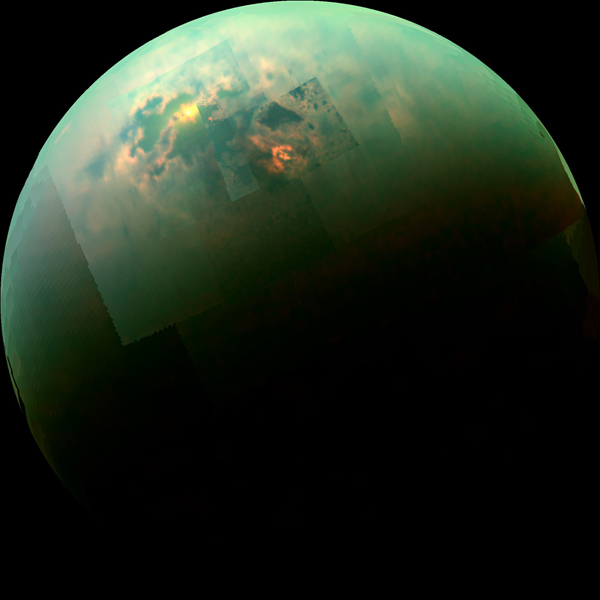
This near-infrared, color view from NASA'S Cassini orbiter shows the sun glinting off of Titan's north polar seas.
This near-infrared, color mosaic from NASA's Cassini spacecraft shows the sun glinting off of Titan's north polar seas. While Cassini has captured, separately, views of the polar seas (see PIA17470) and the sun glinting off of them (see PIA12481 andPIA18433) in the past, this is the first time both have been seen together in the same view.
The sunglint, also called a specular reflection, is the bright area near the 11 o'clock position at upper left. This mirror-like reflection, known as the specular point, is in the south of Titan's largest sea, Kraken Mare, just north of an island archipelago separating two separate parts of the sea.
This particular sunglint was so bright as to saturate the detector of Cassini's Visual and Infrared Mapping Spectrometer (VIMS) instrument, which captures the view. It is also the sunglint seen with the highest observation elevation so far -- the sun was a full 40 degrees above the horizon as seen from Kraken Mare at this time -- much higher than the 22 degrees seen in PIA18433. Because it was so bright, this glint was visible through the haze at much lower wavelengths than before, down to 1.3 microns.
The southern portion of Kraken Mare (the area surrounding the specular feature toward upper left) displays a "bathtub ring" -- a bright margin of evaporate deposits -- which indicates that the sea was larger at some point in the past and has become smaller due to evaporation. The deposits are material left behind after the methane & ethane liquid evaporates, somewhat akin to the saline crust on a salt flat.
The highest resolution data from this flyby -- the area seen immediately to the right of the sunglint -- cover the labyrinth of channels that connect Kraken Mare to another large sea, Ligeia Mare. Ligeia Mare itself is partially covered in its northern reaches by a bright, arrow-shaped complex of clouds. The clouds are made of liquid methane droplets, and could be actively refilling the lakes with rainfall.
The view was acquired during Cassini's August 21, 2014, flyby of Titan, also referred to as "T104" by the Cassini team.
The view contains real color information, although it is not the natural color the human eye would see. Here, red in the image corresponds to 5.0 microns, green to 2.0 microns, and blue to 1.3 microns. These wavelengths correspond to atmospheric windows through which Titan's surface is visible. The unaided human eye would see nothing but haze, as in PIA12528.
The Cassini-Huygens mission is a cooperative project of NASA, the European Space Agency and the Italian Space Agency. JPL, a division of the California Institute of Technology, Pasadena, manages the mission for NASA's Science Mission Directorate in Washington. The VIMS team is based at the University of Arizona in Tucson.
More information about Cassini is available at http://www.nasa.gov/cassini andhttp://saturn.jpl.nasa.gov.