Translate

Samstag, 17. Juli 2010

Water as Human Right Threatens to Split World Body

Water as Human Right Threatens to Split World Body

by Thalif Deen

UNITED NATIONS - A long outstanding proposal to recognize the right to water as a basic universal human right is threatening to split the world's rich and poor nations.

[A long outstanding proposal to recognise the right to water as a  basic universal human right is threatening to split the world's rich and  poor nations. (photo by Flickr user Gary Edenfield)]A long outstanding proposal to recognise the right to water as a basic universal human right is threatening to split the world's rich and poor nations. (photo by Flickr user Gary Edenfield)
Opposition to the proposal is coming mostly from Western nations, says Maude Barlow, a global water advocate and a founder of the Canada-based Blue Planet Project.

"Canada is the worst. But Australia, the United States and Great Britain are also holding up the process," she said.

"I am loath to see this as a North-South issue, but it is beginning to look like it," Barlow told IPS.

If the draft resolution is eventually adopted by the 192- member U.N. General Assembly, "it would be one of the most important things the United Nations has done since the Universal Declaration of Human Rights," she said.

The two-page draft, described as "historic", recognizes "the human right to water and sanitation," and is being initiated by Bolivia.

A final text of the draft, currently under discussions, is expected to be presented to the president of the General Assembly, Ali Abdussalam Treki, by the end of July - if it clears the political hurdles.

Speaking off-the-record, a diplomatic source told IPS: "This is something very dear to developing countries."

It is true that there is actually no legal basis for declaring the right to water and sanitation as a basic universal human right, and issues like definitions and scope have to be worked out. He said the argument being made is there is already an ongoing process in Geneva that is meant to work on this, and that the General Assembly "is jumping the gun".

"Overall, water and sanitation are such critical issues that we must work towards consensus on this resolution. Anything less than consensus would undermine the very importance we attach to them," he warned.

Barlow pointed out that nearly two billion people live in water-stressed areas of the world and three billion have no running water within a kilometer of their homes.

In a letter sent to all 192 U.N. ambassadors, she said that when the 1948 Universal Declaration on Human Rights was written, no one could foresee a day when water would be a contested area.

"But in 2010, it is not an exaggeration to say that the lack of access to clean water is the greatest human rights violation in the world," said Barlow, who once served as Senior Adviser on Water to the 63rd President of the U.N. General Assembly in 2008-2009.

She said Canada has blocked even the most modest steps toward international recognition of the right to water and has worked behind the scenes to derail advancement toward a binding instrument.

Government officials have not explained their position except to say that such a convention might force Canada to share its water with the United States.

However, this is a complete "red herring" and the Stephen Harper government knows it, she added.

The truth is that a right to water convention at the U.N. would act as a counterweight to those who want to sell Canada's water for profit and is a more likely explanation of Canada's continued opposition, Barlow said.

Ann-Mari Karlsson of the Stockholm International Water Institute (SIWI) told IPS her organization supports the human right to water and sanitation.

"But we concur with the views of the U.N. independent expert that the right to water and sanitation are components of the rights to an adequate standard of living and that these rights are protected under Article 11 of the International Covenant on Economic, Social and Cultural Rights," Karlsson said.

She said it is important that a U.N. resolution on the right to water and sanitation should state this clearly, "which as far as we can see, the current draft does not".

What is more, the importance of sanitation in this context cannot be underestimated.

Karlsson said water and sanitation are closely linked, and the world is more off track to reach the Millennium Development Goals on access to sanitation than it is for access to water.

"There should be an adequate reflection of this in the resolution," she added.

Anil Naidoo, also of the Blue Planet Project, has already briefed China and the 130-member Group of 77 developing countries in promoting the draft resolution.

"International and local community groups fighting for water justice have long been calling for leadership from the U.N. in clearly recognizing that water and sanitation are human rights," said Naidoo.

"As this moves forward we are demanding that the language of the resolution remain strong and leave no doubt that water and sanitation are human rights," he added.

Andersson of SIWI told IPS: "We are not against privatization on principle. Our main concern is that the state should take its responsibility to regulate and monitor activities by private actors so that everyone has access to affordable drinking and household water and sanitation."

Whether the provision of water and sanitation is carried out by public or private actors is not relevant to the status of water and sanitation as a human right, she declared.

Meanwhile, a coalition of international non-governmental organizations (NGOs), including the Council of Canadians, Food and Water Europe, Corporate Europe Observatory and the Blue Planet Project, has appealed to members of the European Parliament seeking their political support.

"In light of the European Union's recognition of water as a human right, it will be crucial that the EU play a key role in promoting this key resolution at the United Nations," says the letter.

Water as Human Right Threatens to Split World Body

Water as Human Right Threatens to Split World Body

by Thalif Deen

UNITED NATIONS - A long outstanding proposal to recognize the right to water as a basic universal human right is threatening to split the world's rich and poor nations.

[A long outstanding proposal to recognise the right to water as a  basic universal human right is threatening to split the world's rich and  poor nations. (photo by Flickr user Gary Edenfield)]A long outstanding proposal to recognise the right to water as a basic universal human right is threatening to split the world's rich and poor nations. (photo by Flickr user Gary Edenfield)
Opposition to the proposal is coming mostly from Western nations, says Maude Barlow, a global water advocate and a founder of the Canada-based Blue Planet Project.

"Canada is the worst. But Australia, the United States and Great Britain are also holding up the process," she said.

"I am loath to see this as a North-South issue, but it is beginning to look like it," Barlow told IPS.

If the draft resolution is eventually adopted by the 192- member U.N. General Assembly, "it would be one of the most important things the United Nations has done since the Universal Declaration of Human Rights," she said.

The two-page draft, described as "historic", recognizes "the human right to water and sanitation," and is being initiated by Bolivia.

A final text of the draft, currently under discussions, is expected to be presented to the president of the General Assembly, Ali Abdussalam Treki, by the end of July - if it clears the political hurdles.

Speaking off-the-record, a diplomatic source told IPS: "This is something very dear to developing countries."

It is true that there is actually no legal basis for declaring the right to water and sanitation as a basic universal human right, and issues like definitions and scope have to be worked out. He said the argument being made is there is already an ongoing process in Geneva that is meant to work on this, and that the General Assembly "is jumping the gun".

"Overall, water and sanitation are such critical issues that we must work towards consensus on this resolution. Anything less than consensus would undermine the very importance we attach to them," he warned.

Barlow pointed out that nearly two billion people live in water-stressed areas of the world and three billion have no running water within a kilometer of their homes.

In a letter sent to all 192 U.N. ambassadors, she said that when the 1948 Universal Declaration on Human Rights was written, no one could foresee a day when water would be a contested area.

"But in 2010, it is not an exaggeration to say that the lack of access to clean water is the greatest human rights violation in the world," said Barlow, who once served as Senior Adviser on Water to the 63rd President of the U.N. General Assembly in 2008-2009.

She said Canada has blocked even the most modest steps toward international recognition of the right to water and has worked behind the scenes to derail advancement toward a binding instrument.

Government officials have not explained their position except to say that such a convention might force Canada to share its water with the United States.

However, this is a complete "red herring" and the Stephen Harper government knows it, she added.

The truth is that a right to water convention at the U.N. would act as a counterweight to those who want to sell Canada's water for profit and is a more likely explanation of Canada's continued opposition, Barlow said.

Ann-Mari Karlsson of the Stockholm International Water Institute (SIWI) told IPS her organization supports the human right to water and sanitation.

"But we concur with the views of the U.N. independent expert that the right to water and sanitation are components of the rights to an adequate standard of living and that these rights are protected under Article 11 of the International Covenant on Economic, Social and Cultural Rights," Karlsson said.

She said it is important that a U.N. resolution on the right to water and sanitation should state this clearly, "which as far as we can see, the current draft does not".

What is more, the importance of sanitation in this context cannot be underestimated.

Karlsson said water and sanitation are closely linked, and the world is more off track to reach the Millennium Development Goals on access to sanitation than it is for access to water.

"There should be an adequate reflection of this in the resolution," she added.

Anil Naidoo, also of the Blue Planet Project, has already briefed China and the 130-member Group of 77 developing countries in promoting the draft resolution.

"International and local community groups fighting for water justice have long been calling for leadership from the U.N. in clearly recognizing that water and sanitation are human rights," said Naidoo.

"As this moves forward we are demanding that the language of the resolution remain strong and leave no doubt that water and sanitation are human rights," he added.

Andersson of SIWI told IPS: "We are not against privatization on principle. Our main concern is that the state should take its responsibility to regulate and monitor activities by private actors so that everyone has access to affordable drinking and household water and sanitation."

Whether the provision of water and sanitation is carried out by public or private actors is not relevant to the status of water and sanitation as a human right, she declared.

Meanwhile, a coalition of international non-governmental organizations (NGOs), including the Council of Canadians, Food and Water Europe, Corporate Europe Observatory and the Blue Planet Project, has appealed to members of the European Parliament seeking their political support.

"In light of the European Union's recognition of water as a human right, it will be crucial that the EU play a key role in promoting this key resolution at the United Nations," says the letter.

Freitag, 16. Juli 2010

Shaping NGC 6188

hmmmmm :)

See Explanation.  Clicking on the picture will download  the highest resolution version available.
Shaping NGC 6188
Credit & Copyright: Piotrek Sadowski

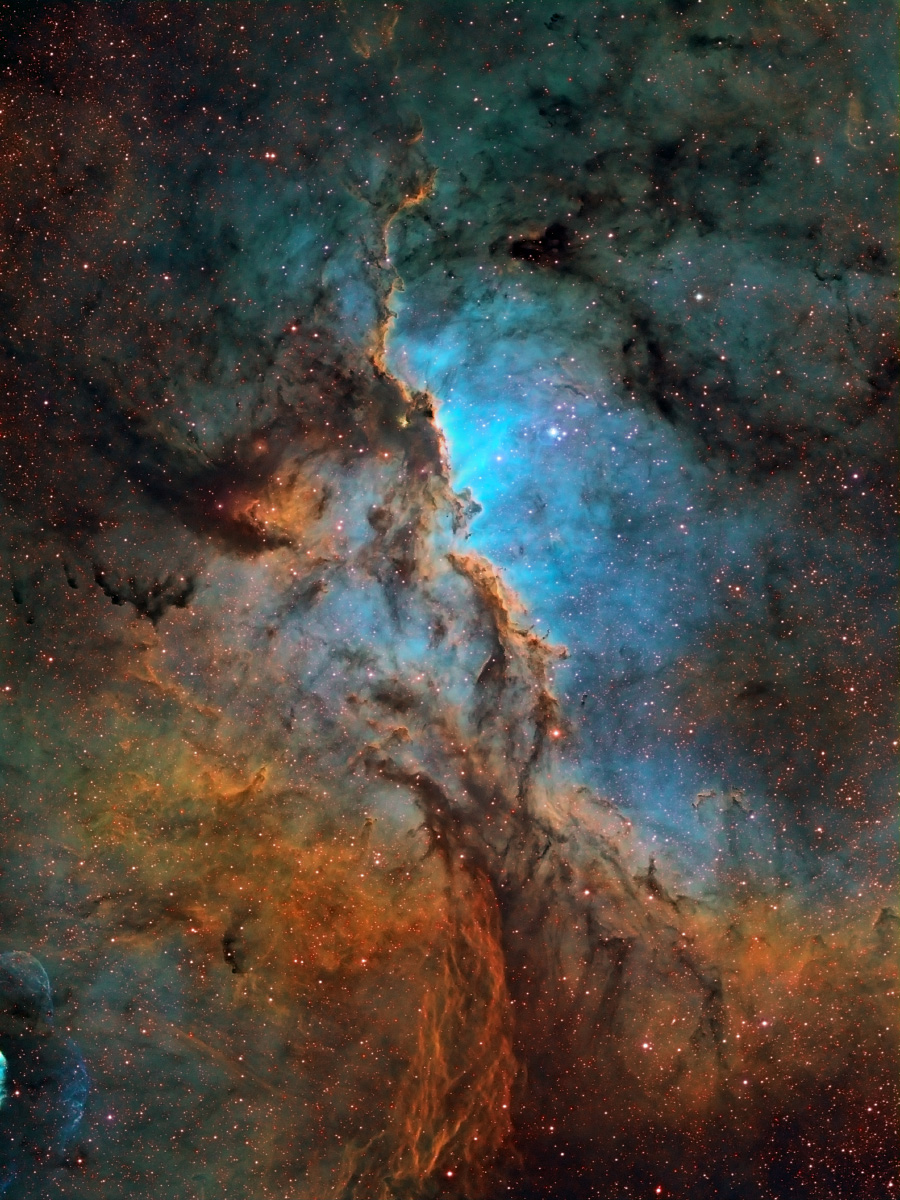
Explanation: Dark shapes with bright edges winging their way through dusty NGC 6188 are tens of light-years long. The emission nebula is found near the edge of an otherwise dark large molecular cloud in the southern constellation Ara, about 4,000 light-years away. Formed in that region only a few million years ago, the massive young stars of the embedded Ara OB1 association sculpt the fantastic shapes and power the nebular glow with stellar winds and intense ultraviolet radiation. The recent star formation itself was likely triggered by winds and supernova explosions, from previous generations of massive stars, that swept up and compressed the molecular gas. A false-color Hubble palette was used to create the this sharp close-up image and shows emission from sulfur, hydrogen, and oxygen atoms in red, green, and blue hues. At the estimated distance of NGC 6188, the picture spans about 200 light-years.


BREAKING: Flow of Oil Halted for First Time Since April

Well.. let's not cheer too much and let's for sure not be thankful for this disaster. F*** BP and the other multinationals!

Flow of Oil Halted for First Time Since April [Updated]


bp-integrity-test-photo.jpg
What's missing from this picture? Oil. Photo: BP

This Doesn't Mean We're Out of the Woods (Yet)
As announced earlier today, BP has started the pressure test on the leaking oil well in the Gulf of Mexico. While the test is running, the flow of oil is stopped, something that hasn't happened since April. Engineers are now monitoring the pressure coming out of the well; If it stays high, this means that the well is probably intact and has maintained its physical integrity despite all the SNAFUs. If it drops, there's probably another leak somewhere underground, making things much more complicated from now on. We'll have to wait a few more hours to find out which it is... And even if it worked, it's far from over ( as Philippe Cousteau says). Read on for more details.

The stoppage came 85 days, 16 hours and 25 minutes after the first report April 20 of an explosion on the Deepwater Horizon oil rig that killed 11 workers and triggered the spill.

Between 95 million and 185 million gallons of crude oil have already spilled into the Gulf, according to government estimates.

Update: As of Friday morning at around 8:45 AM, BP says that "it is encouraged by results [of the pressure test] so far". Kent Wells, BP's vice president, says the pressure is good inside the new cap. But the tests aren't over...

The current test is scheduled to take place in 6-hour increments for 48 hours. Engineers are remotely monitoring the cap for pressure changes and watching for signs of leaks.

If all goes well, the tests could wrap up Saturday afternoon.

Via HuffPo

More on BP Oil Spill
BP's Anti-Leak Equipment was Leaking...
This Can't Be Good: BP Delays Pressure Tests and Stops Drilling Relief Well
BP Says New 'Top Hat' is About 150 Feet From Oil Leak
Could the Russian Mir Submersible Stop the Oil Leak?
BP Cleaning Up Less than 1% of the Oil it Promised the Feds


Cat Rehab Weans Feral Felines Off Endangered Birds

Cat Rehab Weans Feral Felines Off Endangered Birds

cat eating bird photo

It may be a long way from the forests of Japan's Ogasawara Islands to the high-rise apartments of Tokyo, but a special cat rehab helping feral felines find their way by putting to rest their wild side. For the last 15 years or so, the islands have been virtually overrun by an ever growing feral cat population that has a problematic appetite. Turns out, the felines have developed a habit of dining on the islands' wild birds, threatening several endangered species. Now, in an attempt to intervene, officials have begun collecting the cats hoping they'll put down the feather and get back on the can.

According to the Daily Yomiuri, officials from the Tokyo Veterinary Medical Association (TVMA) have been teaming up with locals in their cat collecting efforts in hopes of preserving the island chain's unique ecosystem. It's so worth saving, in fact, that the Ogasawara Islands were selected as candidates to receive a World Heritage Site designation, which has only added impetus to solving the cat crisis.

Several bird species are under attack from the feral cats, including the Bonin flying fox and the endangered Japanese wood pigeon.

Once the cats have been rounded up, they're then sent to Japan's main island, Honshu, where they undergo rehabilitation aimed at making them suitable pets. Getting the wild, bird-eating cats accustomed to domestic life again, however, is no easy task. A spokesperson from the TVMA explains the rehab process to The Telegraph:

It is unusual to turn wild cats into domestic pets. The process involves firstly putting the cat in a cage and then placing the cage in a place where people often pass by. The cat is touched every day and after about a month, can normally be held. The whole process can take up to three months.

Once the cats have finished rehab, they can then be adopted. So far, more than 100 newly tamed cats have found new homes -- and they don't seem to miss their old ways. "Maybe because they missed people, the captured cats show affection once they're tamed," said Yasushi Komatsu, vice chairmen of the TVMA.

Considering the far less humane options thought of by other nations to deal with invasive species, Japan's cat rehab seems to offer a real win-win solution. It just goes to show that with a bit of extra effort given to preserving the lives of endangered species, the lives of those endangering them can be spared too. And who knows, maybe this cat rehab can teach us all a valuable lesson.

More on Solutions to Invasive Species
42 Tons of Rat Poison to be Dropped on Island Paradise
Island Once Overrun by Rats Now Buried in Bunnies
Australia's Invading Camels Soon to Be Croc Food


Paul de octopus heeft eigen iPhone Applicatie

Paul de octopus heeft eigen iPhone Applicatie


De inmiddels wereldberoemde Paul de octopus uit Duitsland heeft vanaf nu een eigen applicatie voor de iPhone. Paul werd bekend vanwege zijn reeks goede voorspellingen voor het WK voetbal in Zuid-Afrika. uTouchLabs.com vond het een goed idee om de hype rondom het beest als basis te gebruiken om een nieuwe applicatie te ontwikkelen.

Ask the octopus oftewel vraag het de octupus doet eigenlijk wat je zou verwachten. Je vult twee zaken in die je wilt vergelijken met elkaar en vervolgens zal Paul naar de bodem van de zee gaan en een keuze maken uit ��n van de twee glazen dozen.

Uiteraard is de keuze volstrekt willekeurig en heeft de digitale Paul geen voorspellende gaven (iets wat ook te betwijfelen valt bij de echte Paul :-) ). Downloaden kan hier.

paul_iphone_2

Donnerstag, 15. Juli 2010

Andes Sunset Eclipse

those pictures are always awesome

some however are superb and this one is one of hem

what a picture, I love it so much

See Explanation.  Clicking on the picture will download  the highest resolution version available.
Andes Sunset Eclipse
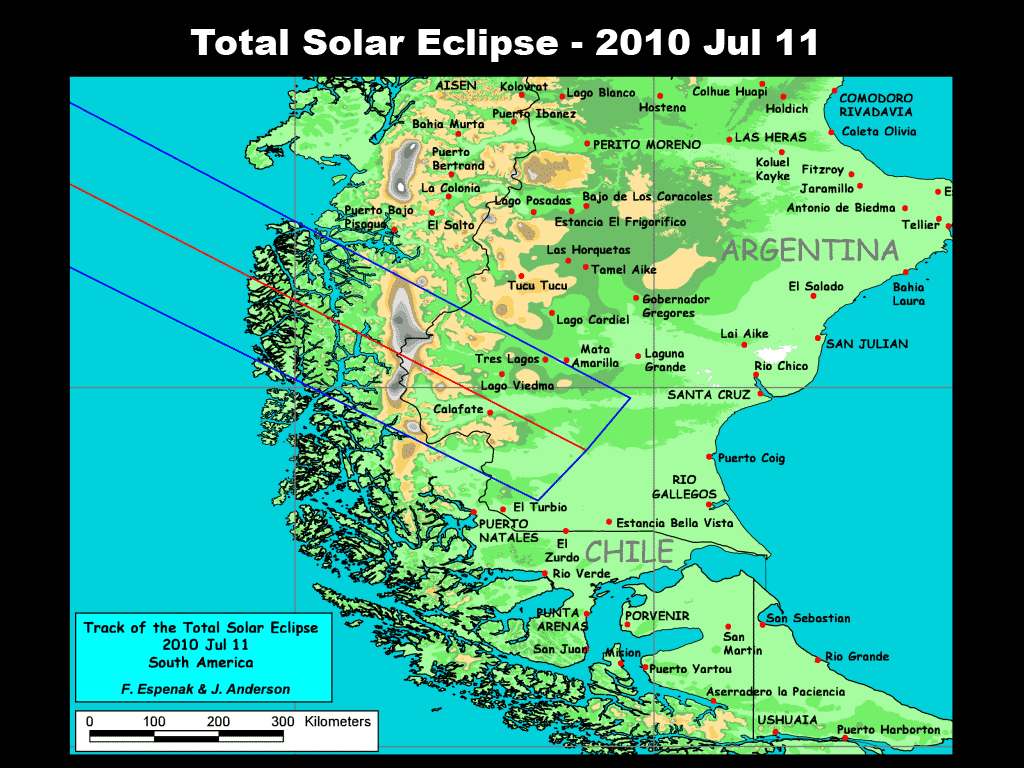
Credit & Copyright: Janne Pyykk�

Explanation: On July 11, after a long trek eastward across the southern Pacific Ocean, the Moon's shadow reached landfall in South America. In a total solar eclipse close to sunset, silhouetted Moon and Sun hugged the western horizon, seen here above the Andes mountains near the continent's southern tip. To enjoy a good vantage point, the photographer hiked to a windy spot about 400 meters above a lake, Lago Argentino, climbing into the picture after setting up his camera on a tripod. At left, the sky outside the shadow cone is still bright. Below, the lights of El Calafate, Patagonia, Argentina, shine by the lake shore.