Translate

Posts mit dem Label planet mercury werden angezeigt. Alle Posts anzeigen

Sonntag, 7. August 2016

Researchers Find Most Volcanic Activity on Mercury Stopped About 3.5 Billion Years Ago
Researchers Find Most Volcanic Activity on Mercury Stopped About 3.5 Billion Years Ago

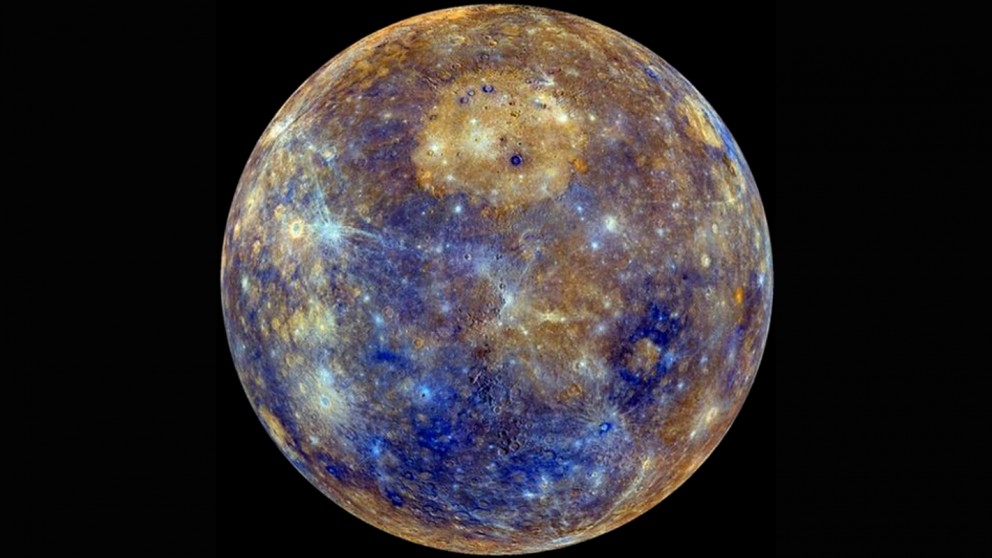
Enhanced color image of Mercury. The bright, circular deposit in the upper center of the image is an enormous effusive volcanic deposit, situated within the largest impact crater on the planet, the Caloris basin. Image credit: NASA/JHU APL/CIW
New research from North Carolina State University finds that major volcanic activity on the planet Mercury most likely ended about 3.5 billion years ago. These findings add insight into the geological evolution of Mercury in particular, and what happens when rocky planets cool and contract in general.
There are two types of volcanic activity: effusive and explosive. Explosive volcanism is often a violent event that results in large ash and debris eruptions, such as the Mount Saint Helens eruption in 1980. Effusive volcanism refers to widespread lava flows that slowly pour out over the landscape — believed to be a key process by which planets form their crusts.
Determining the ages of effusive volcanic deposits can give researchers a handle on a planet’s geological history. For example, effusive volcanism was active a few hundred million years ago on Venus, a few million years ago on Mars, and it still takes place on Earth today. Until now, the duration of effusive volcanic activity on Mercury, made of the same materials as these other planets, had not been known.
NC State assistant professor and planetary geologist Paul Byrne and colleagues determined when the bulk of Mercury’s crust-forming volcanism ended by using photographs of the surface imaged by NASA’s MESSENGER mission. Because there are no physical samples from the planet that could be used for radiometric dating, the researchers used crater size–frequency analysis, in which the number and size of craters on the planet’s surface are placed into established mathematical models, to calculate absolute ages for effusive volcanic deposits on Mercury.
According to their results, major volcanism on Mercury stopped at around 3.5 billion years ago, in stark contrast to the volcanic ages found for Venus, Mars and Earth.
“There is a huge geological difference between Mercury and Earth, Mars or Venus,” Byrne says. “Mercury has a much smaller mantle, where radioactive decay produces heat, than those other planets, and so it lost its heat much earlier. As a result, Mercury began to contract, and the crust essentially sealed off any conduits by which magma could reach the surface.
“These new results validate 40-year-old predictions about global cooling and contraction shutting off volcanism,” Byrne continues. “Now that we can account for observations of the volcanic and tectonic properties of Mercury, we have a consistent story for its geological formation and evolution, as well as new insight into what happens when planetary bodies cool and contract.”
The research appears in Geophysical Research Letters, with co-authors from the Carnegie Institution of Washington, Mount Holyoke College, the University of Georgia, Southwest Research Institute and Brown University. The MESSENGER mission provided substantial funding for this work.

Dienstag, 16. Dezember 2014

Carnegie Hosts Crater-Naming Contest

Carnegie Hosts Crater-Naming Contest

Washington, D.C—The MESSENGER Education and Public Outreach (EPO) Team is launching a competition this week to namefive impact craters on Mercury. The contest is open to all Earthlings, except for members of the mission’s EPO team. The contest runs from December 15, 2014, to January 15, 2015.
NASA’s MESSENGER spacecraft has been in orbit about Mercury since March 2011. The mission’s EPO team is led by Julie Edmonds of the Carnegie Institution for Science.
According to the International Astronomical Union (IAU)—the governing body of planetary and satellite nomenclature since 1919—all new craters on Mercury must be named after an artist, composer, or writer who was famous for more than 50 years and has been dead for more than three years. See the current list of named Mercury craters.
The EPO team’s contest allows the public to immortalize an important person in the arts and humanities from anywhere in the world. Submissions will be accepted beginning midnight (00:00 UTC) on December 15, 2014, until January 15, 2015 (23:59 UTC). Fifteen finalist names for craters will be submitted to theInternational Astronomical Union (IAU) for selection of the five winners. Winning submissions will be announced by the IAU to coincide with the end of MESSENGER’s orbital operations in late March or April 2015. IAU decisions will be final.
The MESSENGER spacecraft has far surpassed expectations both in the duration of the mission and in the quality and quantity of data. The mission will end this spring as the tiny craft succumbs to gravity and impacts on Mercury. The EPO team organized the competition to celebrate the mission’s achievements.
Edmonds advises participants to first research the artist, composer, or writer under consideration before filling out the contest entry. “Once online, registrants will be asked to submit a short description of their chosen individual’s contributions to their field, as well as an authoritative source for background information,” she said.
The name cannot have any political, religious, or military significance. Nor can other features in the Solar System have the same name. For example, Ansel Adams is not eligible because there is a feature on the Moon with the name Adams (even though it was not named for Ansel). Participants can check their ideas against the list of named Solar System features and enter the name in the “Search by Feature Name” box in the upper right corner.
“This brave little craft, not much bigger than a Volkswagen Beetle, has travelled more than 8 billion miles since 2004—getting to the planet and then in orbit,” Edmonds said. “We would like to draw international attention to the achievements of the mission and the guiding engineers and scientists on Earth who have made the MESSENGER mission so outstandingly successful.”
The goal of MESSENGER was to take 2,500 images of the planet, but is has returned more than 250,000 images. “We now have a detailed, high-resolution map of the entire planet,” Edmonds noted. “As scientists study the incredible data returned by MESSENGER, it becomes important to give names to surface features that are of special scientific interest. Having names for landforms such as mountains, craters, and cliffs makes it easier for scientists and others to communicate.”
Enter the contest online at http://namecraters.carnegiescience.edu/.
________________________________________
The Carnegie Institution for Science (carnegiescience.edu) is a private, nonprofit organization headquartered in Washington, D.C., with six research departments throughout the U.S. Since its founding in 1902, the Carnegie Institution has been a pioneering force in basic scientific research. Carnegie scientists are leaders in plant biology, developmental biology, astronomy, materials science, global ecology, and Earth and planetary science.
MESSENGER (MErcury Surface, Space ENvironment, GEochemistry, and Ranging) is a NASA-sponsored scientific investigation of the planet Mercury and the first space mission designed to orbit the planet closest to the Sun. The MESSENGER spacecraft was launched on August 3, 2004, and entered orbit about Mercury on March 18, 2011 (UTC), to begin its primary mission – a yearlong study of its target planet. MESSENGER’s first extended mission began on March 18, 2012, and ended one year later. MESSENGER is now in a second extended mission, which is scheduled to conclude in late March or April 2015. Sean C. Solomon, the Director of Columbia University's Lamont-Doherty Earth Observatory, leads the mission as Principal Investigator. The Johns Hopkins University Applied Physics Laboratory built and operates the MESSENGER spacecraft and manages this Discovery-class mission for NASA.