Translate

Posts mit dem Label hubble werden angezeigt. Alle Posts anzeigen

Montag, 19. Oktober 2015

Starburst galaxy Messier 94

Starburst galaxy Messier 94

This image shows the galaxy Messier 94, which lies in the small northern constellation of the Hunting Dogs, about 16 million light-years away.
Within the bright ring around Messier 94 new stars are forming at a high rate and many young, bright stars are present within it – thanks to this, this feature is called a starburst ring.
The cause of this peculiarly shaped star-forming region is likely a pressure wave going outwards from the galactic centre, compressing the gas and dust in the outer region. The compression of material means the gas starts to collapse into denser clouds. Inside these dense clouds, gravity pulls the gas and dust together until temperature and pressure are high enough for stars to be born.
Credit:
ESA/Hubble & NASA

Mittwoch, 14. Oktober 2015

Hubble’s planetary portrait captures changes in Jupiter’s Great Red Spot

Hubble’s planetary portrait captures changes in Jupiter’s Great Red Spot

13 October 2015
Scientists using the NASA/ESA Hubble Space Telescope have produced new maps of Jupiter that show the continuing changes in its famous Great Red Spot. The images also reveal a rare wave structure in the planet’s atmosphere that has not been seen for decades. The new image is the first in a series of annual portraits of the Solar System’s outer planets, which will give us new glimpses of these remote worlds, and help scientists to study how they change over time.
In this new image of Jupiter a broad range of features has been captured, including winds, clouds and storms. The scientists behind the new images took pictures of Jupiter using Hubble’s Wide Field Camera 3 over a ten-hour period and have produced two maps of the entire planet from the observations. These maps make it possible to determine the speeds of Jupiter’s winds, to identify different phenomena in its atmosphere and to track changes in its most famous features.
The new images confirm that the huge storm, which has raged on Jupiter’s surface for at least three hundred years, continues to shrink, but that it may not go out without a fight. The storm, known as the Great Red Spot, is seen here swirling at the centre of the image of the planet. It has been decreasing in size at a noticeably faster rate from year to year for some time. But now, the rate of shrinkage seems to be slowing again, even though the spot is still about 240 kilometres smaller than it was in 2014.
The spot’s size is not the only change that has been captured by Hubble. At the centre of the spot, which is less intense in colour than it once was, an unusual wispy filament can be seen spanning almost the entire width of the vortex. This filamentary streamer rotates and twists throughout the ten-hour span of the Great Red Spot image sequence, distorted by winds that are blowing at 540 kilometres per hour.
There is another feature of interest in this new view of our giant neighbour. Just north of the planet’s equator, researchers have found a rare wave structure, of a type that has been spotted on the planet only once before, decades ago by the Voyager 2 mission, which was launched in 1977. In the Voyager 2 images the wave was barely visible and astronomers began to think its appearance was a fluke, as nothing like it has been seen since, until now.
The current wave was found in a region dotted with cyclones and anticyclones. Similar waves — called baroclinic waves — sometimes appear in the Earth’s atmosphere where cyclones are forming. The wave may originate in a clear layer beneath the clouds, only becoming visible when it propagates up into the cloud deck, according to the researchers.
The observations of Jupiter form part of the Outer Planet Atmospheres Legacy (OPAL) programme, which will allow Hubble to dedicate time each year to observing the outer planets. In addition to Jupiter, Neptune and Uranus have already been observed as part of the programme and maps of these planets will be placed in the public archive. Saturn will be added to the series later. The collection of maps that will be built up over time will help scientists not only to understand the atmospheres of giant planets in the Solar System, but also the atmospheres of our own planet and of the planets that are being discovered around other stars.

Notes

The findings are described in an Astrophysical Journal paper First results from the Hubble OPAL program: Jupiter in 2015, available online.

Notes for editors

The Hubble Space Telescope is a project of international cooperation between ESA and NASA.

More information

Image credit: NASA, ESA, A. Simon (GSFC), M. Wong (UC Berkeley), and G. Orton (JPL-Caltech)

Links


Freitag, 6. März 2015

Hubble sees multiple images of a supernova for the very first time

An explosive quartet

Hubble sees multiple images of a supernova for the very first time

5 March 2015

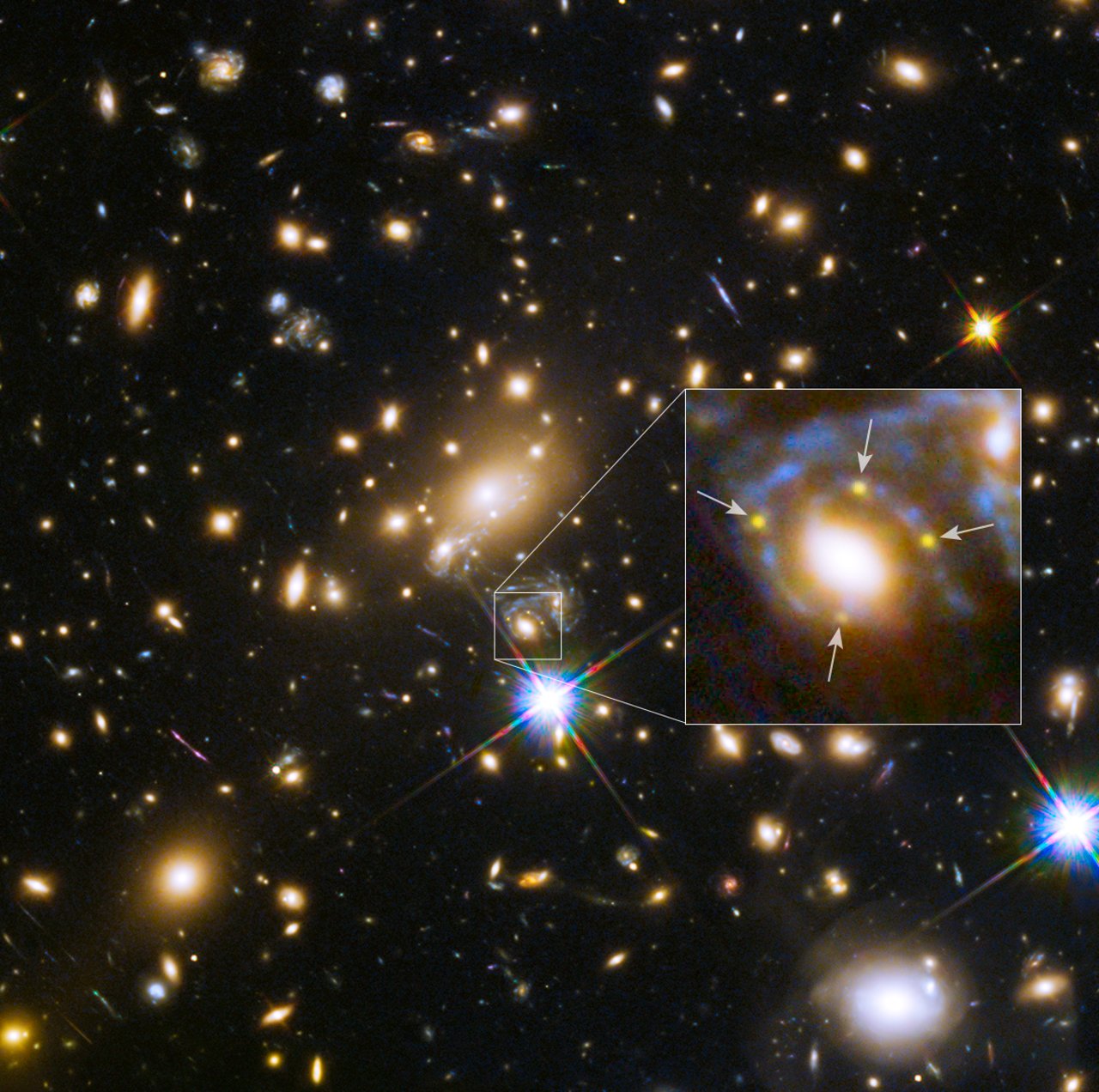
Astronomers using the NASA/ESA Hubble Space Telescope have, for the first time, spotted four images of a distant exploding star. The images are arranged in a cross-shaped pattern by the powerful gravity of a foreground galaxy embedded in a massive cluster of galaxies. The supernova discovery paper will appear on 6 March 2015 in a special issue of Science celebrating the centenary of Albert Einstein’s theory of general relativity.
Whilst looking closely at a massive elliptical galaxy and its associated galaxy clusterMACS J1149+2223 — whose light took over 5 billion years to reach us— astronomers have spotted a strange and rare sight. The huge mass of the galaxy and the cluster is bending the light from a much more distant supernova behind them and creating four separate images of it. The light has been magnified and distorted due to gravitational lensing [1] and as a result the images are arranged around the elliptical galaxy in a formation known as an Einstein cross.
Although astronomers have discovered dozens of multiply imaged galaxies andquasars, they have never before seen multiple images of a stellar explosion.
“It really threw me for a loop when I spotted the four images surrounding the galaxy — it was a complete surprise,” said Patrick Kelly of the University of California Berkeley, USA, a member of the Grism Lens Amplified Survey from Space (GLASS)collaboration and lead author on the supernova discovery paper. He discovered the supernova during a routine search of the GLASS team’s data, finding what the GLASS group and the Frontier Fields Supernova team have been searching for since 2013 [2]. The teams are now working together to analyse the images of the supernova, whose light took over 9 billion years to reach us [3].
“The supernova appears about 20 times brighter than its natural brightness,”explains the paper’s co-author Jens Hjorth from the Dark Cosmology Centre, Denmark. “This is due to the combined effects of two overlapping lenses. The massive galaxy cluster focuses the supernova light along at least three separate paths, and then when one of those light paths happens to be precisely aligned with a single elliptical galaxy within the cluster, a secondary lensing effect occurs.” The dark matter associated with the elliptical galaxy bends and refocuses the light into four more paths, generating the rare Einstein cross pattern the team observed.
This unique observation will help astronomers refine their estimates of the amount and distribution of dark matter in the lensing galaxy and cluster. There is more dark matter in the Universe than visible matter, but it is extremely elusive and is only known to exist via its gravitational effects on the visible Universe, so the lensing effects of a galaxy or galaxy cluster are a big clue to the amount of dark matter it contains.
When the four supernova images fade away as the explosion dies down, astronomers will have a rare chance to catch a rerun of the explosion. The supernova images do not arrive at the Earth at the same time because, for each image produced, the light takes a different route. Each route has a different layout of matter — both dark and visible — along its path. this causes bends in the road, and so for some routes the light takes longer to reach us than for others. Astronomers can use their model of how much dark matter is in the cluster, and where it is, to predict when the next image will appear as well as using the time delays they observe to make the mass models even more accurate [4].
“The four supernova images captured by Hubble appeared within a few days or weeks of each other and we found them after they had appeared,” explains Steve Rodney of Johns Hopkins University, USA, leader of the Frontier Fields Supernova team. “But we think the supernova may have appeared in a single image some 20 years ago elsewhere in the cluster field, and, even more excitingly, it is expected to reappear once more in the next one to five years — and at that time we hope to catch it in action.”
The supernova has been nicknamed Refsdal in honor of Norwegian astronomer Sjur Refsdal, who, in 1964, first proposed using time-delayed images from a lensed supernova to study the expansion of the Universe. “Astronomers have been looking to find one ever since,” said Tommaso Treu of the University of California Los Angeles, USA, the GLASS project’s principal investigator. “And now the long wait is over!”

Notes

[1] Gravitational lensing was first predicted by Albert Einstein. This effect is similar to a glass lens bending light to magnify and distort the image of an object behind it.
[2] The Frontier Fields is a three-year programme that uses Hubble to observe six massive galaxy clusters to probe not only what is inside the clusters but also what is beyond them through gravitational lensing. The GLASS survey uses Hubble’s capabilities to study remote galaxies using ten massive galaxy clusters as gravitational lenses, including the six in the Frontier Fields.
[3] The team used the W. M. Keck Observatory on Mauna Kea, in Hawaii, to measure the redshift of the supernova’s host galaxy, which is a proxy to its distance.
[4] Measuring the time delays between images offers clues to the type of warped-space terrain the supernova’s light had to cover and will help the astronomers fine tune the models that map out the cluster’s mass.

Notes for editors

The Hubble Space Telescope is a project of international cooperation between ESA and NASA.
The international team of astronomers in this study consists of P. Kelly (University of California, Berkeley, USA); S. Rodney (The Johns Hopkins University, USA); T. Treu (University of California, Los Angeles, USA); R. Foley (University of Illinois at Urbana-Champaign, USA); G. Brammer (Space Telescope Science Institute, USA); K. Schmidt (University of California, Santa Barbara, USA); A. Zitrin (California Institute of Technology, USA); A. Sonnenfeld (University of California, Los Angeles, USA); L. Strolger (Space Telescope Science Institute, USA & Western Kentucky University, USA); O. Graur (New York University, USA), A. Filippenko (University of California, Berkeley, USA), S. Jha (Rutgers, USA); A. Riess (The Johns Hopkins University, USA & Space Telescope Science Institute, USA); M. Bradac (University of California, Davis, USA), B. Weiner (Steward Observatory, USA); D. Scolnic (The Johns Hopkins University, USA); M. Malkan (University of California, Los Angeles, USA); A. von der Linden (Dark Cosmology Centre, Denmark); M. Trenti (University of Melbourne, Australia); J. Hjorth (Dark Cosmology Centre, Denmark); R. Gavazzi (Institut d’Astrophysique de Paris, France); A. Fontana (INAF-OAR, Italy); J. Merten (California Institute of Technology, USA); C. McCully (University of California, Santa Barbara,, USA); T. Jones (University of California, Santa Barbara,, USA); M. Postman (Space Telescope Science Institute, USA); A. Dressler (Carnegie Observatories, USA), B. Patel (Rutgers, USA), S. Cenko (NASA/Goddard Space Flight Center, USA); M. Graham (University of California, Berkeley, USA); and Bradley E. Tucker (University of California, Berkeley, USA).

More information

Image credit: NASA, ESA, S. Rodney (John Hopkins University, USA) and the FrontierSN team; T. Treu (University of California Los Angeles, USA), P. Kelly (University of California Berkeley, USA) and the GLASS team; J. Lotz (STScI) and the Frontier Fields team; M. Postman (STScI) and the CLASH team; and Z. Levay (STScI)

Links

Freitag, 18. April 2014

A cross-section of the Universe

A cross-section of the Universe

17 April 2014

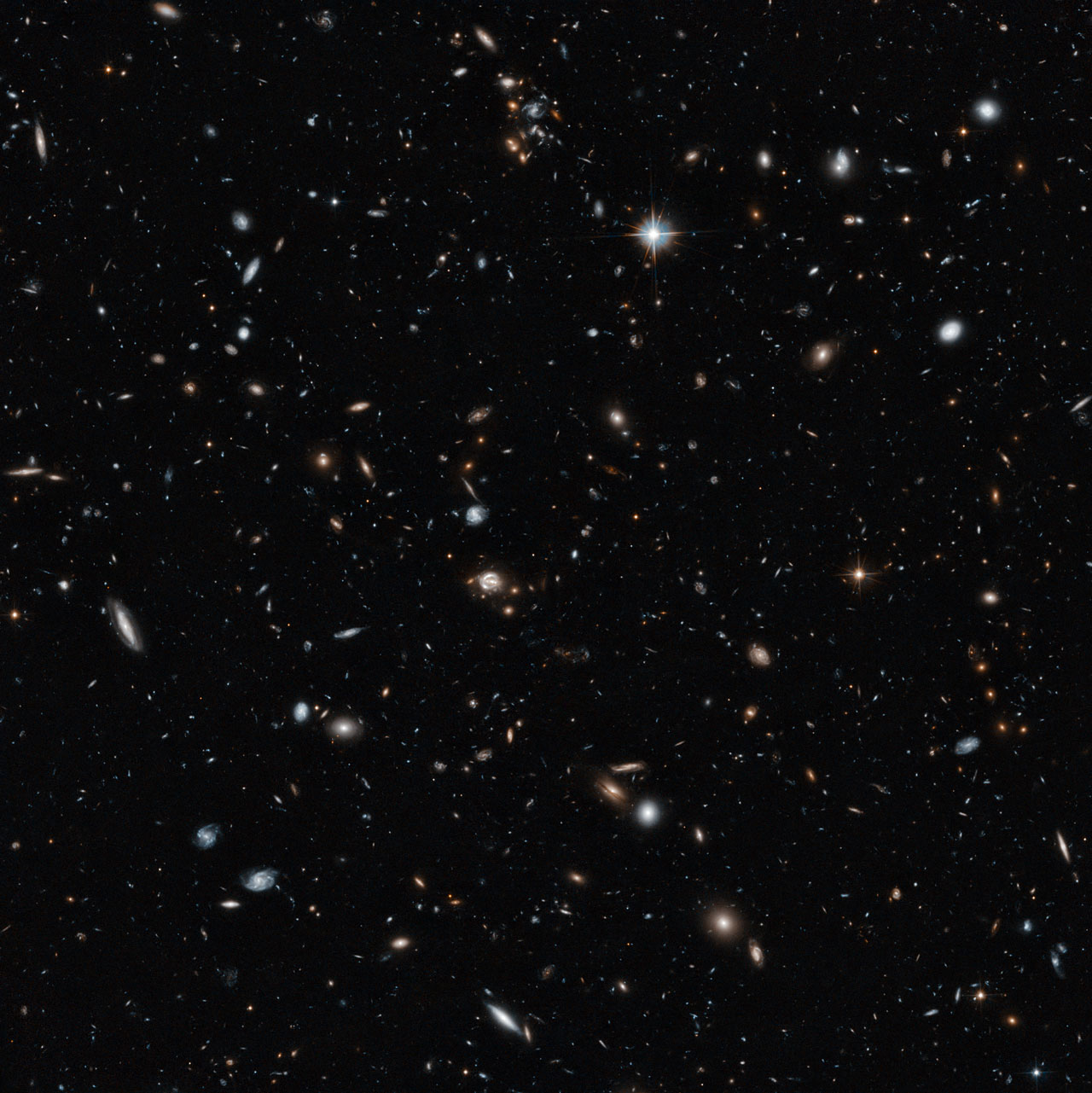
An image of a galaxy cluster taken by the NASA/ESA Hubble Space Telescope gives a remarkable cross-section of the Universe, showing objects at different distances and stages in cosmic history. They range from cosmic near neighbours to objects seen in the early years of the Universe. The 14-hour exposure shows objects around a billion times fainter than can be seen with the naked eye.
This new Hubble image showcases a remarkable variety of objects at different distances from us, extending back over halfway to the edge of the observable Universe. The galaxies in this image mostly lie about five billion light-years from Earth but the field also contains other objects, both significantly closer and far more distant.
Studies of this region of the sky have shown that many of the objects that appear to lie close together may actually be billions of light-years apart. This is because several groups of galaxies lie along our line of sight, creating something of an optical illusion. Hubble’s cross-section of the Universe is completed by distorted images of galaxies in the very distant background.
These objects are sometimes distorted due to a process called gravitational lensing, an extremely valuable technique in astronomy for studying very distant objects [1]. This lensing is caused by the bending of the space-time continuum by massive galaxies lying close to our line of sight to distant objects.
One of the lens systems visible here is called CLASS B1608+656, which appears as a small loop in the centre of the image. It features two foreground galaxies distorting and amplifying the light of a distant quasar the known as QSO-160913+653228. The light from this bright disc of matter, which is currently falling into a black hole, has taken nine billion years to reach us — two thirds of the age of the Universe.
As well as CLASS B1608+656, astronomers have identified two other gravitational lenses within this image. Two galaxies, dubbed Fred and Ginger by the researchers who studied them, contain enough mass to visibly distort the light from objects behind them. Fred, also known more prosaically as [FMK2006] ACS J160919+6532, lies near the lens galaxies in CLASS B1608+656, while Ginger ([FMK2006] ACS J160910+6532) is markedly closer to us. Despite their different distances from us, both can be seen near to CLASS B1608+656 in the central region of this Hubble image.
To capture distant and dim objects like these, Hubble required a long exposure. The image is made up of visible and infrared observations with a total exposure time of 14 hours.

Notes

[1] Gravitational lensing can amplify the light coming from distant objects, enabling telescopes like Hubble to see objects that would otherwise be too faint and far away. This effect will be exploited during the Frontier Fields observing campaign in the near future, which aims to combine the power of Hubble with the natural amplification caused by strong gravitational lensing of distant galaxy clusters, to study the past Universe.

More information

The Hubble Space Telescope is a project of international cooperation between ESA and NASA.
The image was spotted by contestant Adam Kill in the 2012 Hubble's Hidden Treasures competition. Hidden Treasures invited members of the public to search Hubble's science for the best overlooked images that have never been seen by a general audience. This image of CLASS B1608+656 has been well-studied by scientists over the years, but this is the first time it has been published in full online.

Links